Showing posts with label Nation - Germany. Show all posts

12 August 2026

Germany Passenger Car Sales : 2026 (Jan-July)


Registrations were down 10% in July but down 5% YTD. The 2025 share figure below is for a full year. Volkswagen is where you would expect it to be in a country that supports its car industry. VW owned Škoda is doing well if it can elbow Mercedes-Benz out of the way. It's already done that to BMW. 

Toyota fell out of the top ten, with a 29% decline of market share. It needs to up its game. Chinese brands are not enjoying the success here that they are having in many other countries, but it may change. 

SEAT and Cupra sales are combined by the source, but are separated here. I don't know why they persist in doing it this way. Separation can't be done perfectly, but I've estimated what I do not know.

Other oddities is Cadillac being the only GM product listed when nearly all the sales for GM aren't for that brand. GM sold 1,300 cars here last year. Virtually all were not reported until several months later. There are other lesser examples of that too. 

Data source: KBA. Photo source: Fiat (Grande Panda) & Tesla (Model Y).

12 February 2026

Mexico German Car Production : 2025


BMW, Mercedes-Benz and VW/Audi manufacture cars in Mexico. Wage costs, the proximity to the US and Mexico having extensive free trade agreements contribute to the desirability to have plants there. 

BMW: The 2-Series Coupe, M2 and 3-Series are made here. A battery assembly facility is also underway with BEV models to made here in future. 

Mercedes-Benz: The GLB is made at a joint venture plant with Nissan assembly but that will cease in mid 2026, ending M-B production in Mexico.

VW/Audi: The Audi Q5 is made here, along with three VW models. The Golf will come here in 2027 and BEV models are planned. 

Summary: In total, 634,800 vehicles were made here by German manufacturers. M-B soon leaving is a blip but there will be continued investment by the other two companies.

Data source: INEGI. Photo: VW.

14 January 2026

Germany Top 50 Models: 2025


There were 545,000 BEVs (electric cars) accounting for 19% of registrations and an increase of 43%. Hybrids came to 1.127,500 units (+19%) and securing 39.5% of the market. LPG sales came to 12,000. As for fossil fuel cars, 777,600 were petrol and 395,000 diesel.

The chart is colour coded to show where the brand originates. 

Data source: KBA. Photo source: VW & Opel.

13 January 2026

Germany Passenger Car Sales : 2025


Registrations were up 1% for 2025. Not a bad result, but still some way short of the best of years several years ago. In fact, 2025 was 7.5% below the average of the previous ten years.
 
VW leads the way and it is gaining ground. Sales were up 3% and close to one in five cars sold. Mercedes-Benz and Audi are the same as last year and BMW is up. VW's Škoda is rubbing shoulders with these premium marques. Opel has lost still more of its share of the pie but has at least held its ranking.  

Chinese companies are here but are yet to make much of an impact. The British Chinese brand MG is back on 23rd, BYD 24th and Leapmotor has lived up to its name by jumping to 31st. 

There are some quirks with the data supplied. Cupra sales are counted with SEAT and I have separated them as best I can but a few Cupra sales are included in the SEAT figures. Genesis is counted within Hyundai but at least that is easy to separate. 

About half way through the following year, sales data is released for the previous year and I have noticed that Aston Martin and GM US sales are much higher in the new data. So I have increased their sales in 2025 to reflect what is a more realistic number. 

For 2024 articles, simply click on the links below:


Data source: KBA. Picture Sources: VW (Tiguan), Stellantis (Opel Corsa).


11 January 2025

Germany Top 50 : 2023-24


The market here is very much a supporter of things European, or perhaps more accurately with a domestic connection. The VW is always on top despite the rise of the SUV. True, the gap has been closing but for this year the Golf extended its lead.  

The Tesla Model Y fell back 35%, showing the transition to electric propulsion is anything but a smooth road. The VW ID.4 / ID.5 confirmed this with a 41% decline in volume. There are so many predictions made about the car industry, few if any deliver anywhere near what is expected. 

Data source: KBA. Pictures VW.

10 January 2025

Germany Passenger Car Sales : 2024


Registrations were down 7% in December and are 1% for the year. VW is by far the main volume player here with over double the lead over second placed Mercedes-Benz. With 19.1% of all sales, that's the highest percentage since 2016, so the German love affair with the people's car continues. 

The three main German premium marques didn't do that well with Audi losing the most. BMW came home with an ever so slight market gain. Porsche isn't overly successful in Germany but seems to be remedying that in 2024. VW's Škoda has passed Audi although the advantage is marginal. 

I estimated SEAT and Cupra based on Cupra models I do know and the rest are an estimate based on 2023 in which I do have all Cupra sales by model. Sales for these two brands are not separated by KBA until sometime after the year has concluded. As B. Joel said, don't ask me why.  

I updated the list on 19.07.2025 as more information came in. I added some brands and a few that were on the list were modified to improve accuracy. All of that to get extras down to 8,400! 

Data source: KBA. Pictures: Manufacturers.


23 January 2024

Germany / UK Brand Comparison : 2023

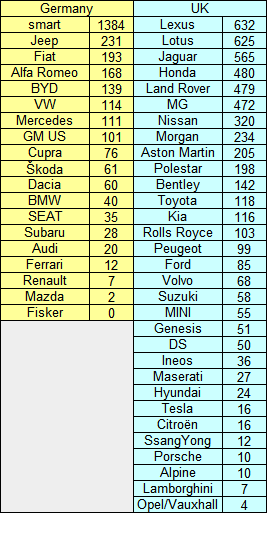
Lexus has over 600% more market share in the UK

The two largest car markets in Europe are compared in a brand head to head. Market share is compared and a percentage figure favouring one country appears in that country's side of the charts. Some predictable outcomes and the odd surprise.

Overview: The UK has more brands on its side because the number one in both countries (VW) leans heavily in favour of Germany in terms of percentage, which soaks up a lot of market share.


German brands:
VW and Mercedes-Benz are both over 100% larger in Germany. VW is number one in both locations but massively more so in Germany. BMW has 40% more market share in Germany and Audi 20%. 

German owned Škoda, smart, SEAT and Cupra all do better in that country. Surprisingly, Porsche has 10% more market share in the UK than its home market. 

UK Brands: They do much better at home, especially as the German market is very parochial which accentuates that. For example, Jaguar has 565% more market share in the UK without being as popular as it should be there. 

French Brands: Renault and its budget brand Dacia do better in Germany but the rest favour the UK. Peugeot has double the market share in the UK. 


Japanese brands: Subaru and Mazda make the Germany side but all the others are in the UK. Honda has nearly 500% more market share in the UK! Mitsubishi isn't sold in the UK so not included.

The rest: Korea is stronger in the UK. The USA is divided with Jeep and GM on opposite sides to Ford and Tesla. Fiat and Ferrari are on the German side but Lamborghini and Maserati the other.  

Volvo has 68% more market share in the UK and Polestar 198%. BYD is stronger in Germany and Fisker was about even. 

Summary: Few surprises here with Germany very supportive of its car industry at the expense of most others. The UK has just about thrown its industry away with incompetence at all levels but still has some premium marques that are given some support at home.  

Opel is just about as popular as Vauxhall 

12 January 2024

Germany Top 50 Passenger Cars : 2023


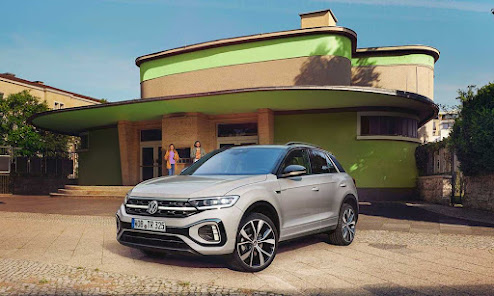
The VW Golf (pictured above) has been a huge success for the company but its role is diminishing as SUVs and Crossover types take over. Certainly, the gap between the Golf and the chasing pack has been whittled down but here the Golf is still top. An element of conservatism or a case of enduring loyalty for this once dominant model? 

VW has the top three places with the Opel Corsa (pictured below) in at fourth. Few models with brands hailing from outside of Europe make this list so the Model Y is an outlier in that regard. I coloured German brands yellow to emphasise their dominance here. Most of the European listings (pale blue) are German owned too.

Data source: KBA.

11 January 2024

Germany Passenger Car Sales : 2023


Hands up all those who thought VW would be the biggest selling brand in Germany? Well done. It's been the best selling brand in the country since its inception. Mercedes-Benz is well back in second while Audi is now comfortably ahead of BMW. The latter stated it was not pushing volume anymore so no surprise there.

Registrations were up 7% for the year but surprisingly subdued in December, down 23%. It has been said the abrupt ending of an electric car incentive scheme in late December was a major factor. Seeing as applications already submitted would be honoured and also the lateness of the cut off I can't see that having much impact in 2023. I wonder what the real reason was.  

Tesla now has a plant in Germany but it still isn't in the top ten. Was part of Elon's plan to win German buyers over? If so, it may need more time to work as the locals are notorious for supporting their car industry and brands owned locally. The removal of the BEV incentive scheme won't be helpful in 2024 either.   

The top four in the list below had their best market share since 2016. All of them increased their market share individually (green shading). It's as predictable as Bayern München winning the Bundesliga. Especially now they've got 'Arry. 

Cupra is strangely still included in the SEAT total by the KBA so I separate them as best I can. I have exact 2022 figures but not 2023 so the latter are estimates that are close to reality. There are also many marques not included by KBA which make up the large 'Other' figure. Mclaren is an obvious example. 

Data source: KBA.

09 January 2023

Germany Top 50 Sales By Model : 2022


Not many surprises to be found here, unless you didn't already know that support for Geman made, owned or designed cars is obligatory for most people here. Very much like Japan with its car industry although not quite as extreme as that.  

The Toyota Yaris includes the Cross version as well, not something I would do by choice nor usually done elsewhere but they can do as they see fit and fair enough. MINI is missing because it's all one model, be it a hatch or Countryman or Clubman. I think someone needs to tell the KBA. Cupra is still bundled together with SEAT. 

Data source: KBA.

08 January 2023

Germany Sales : 2022


Registrations for December were up an impressive 38% and for the year +1%. That was quite a turn around! Of course, last year was a poor one, the worst since 1985. The '+/- diff' column below is for market share change.  

VW leads by a country mile but not quite to the same degree. Toyota reentered the top ten after being out of it for a while. It was as high as seventh back in 2007. The data supplier persists with combining SEAT and Cupra, one of the few remaining holdouts. I use the Formentor and Born sales to show Cupra volume. I'd say Cupra is cannibalising some sales from SEAT but combined there is gain. 

Audi passed BMW which I assume gave the brand some satisfaction. Lynk & Co arrived and had an immediate impact. The 'Other' figure (sonstige) at the bottom of the chart is getting larger and I wonder if that will be addressed at some point. 

Data source: KBA.


14 January 2022

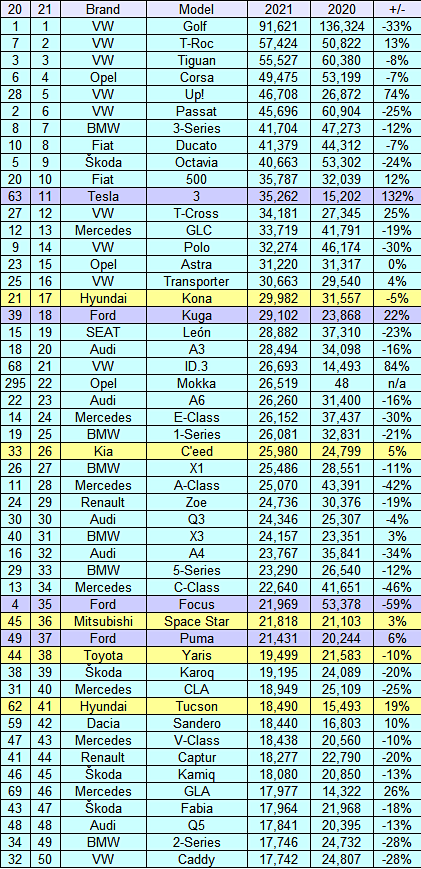
Germany Top 50 Sales By Model : 2021


With total sales down 10%, and a million units fewer than 2019, some of the numbers are sobering for manufacturers. I colour coded the list to show where brands historically originated. From that we see overwhelming support for Euro brands, especially any that are connected with Germany. 

Tesla got close to the top ten with its Model 3 but it may get one up there in 2022. It now has a factory in Germany so another brand with a local connection to support. Hyundai did well with the Kona and Ford with the Kuga. With the Focus falling from 4th to 35th, a model is needed to step up to the plate.

The MINI Hatch should be on the list but as the source releases sales as a total rather than breakdown the model variants, I had to leave it off the list. The Hatch is the most popular of the range and probably achieved around 20,000 registrations.

Point of interest: The VW Golf secured 211,500 registrations in 2019 but only 91,600 in 2021. The chip shortage had an effect but there is no denying it is in sharp decline. As a point of reference, over the same period, the T-Roc has maintained its volume. 

Data source: KBA.

13 January 2022

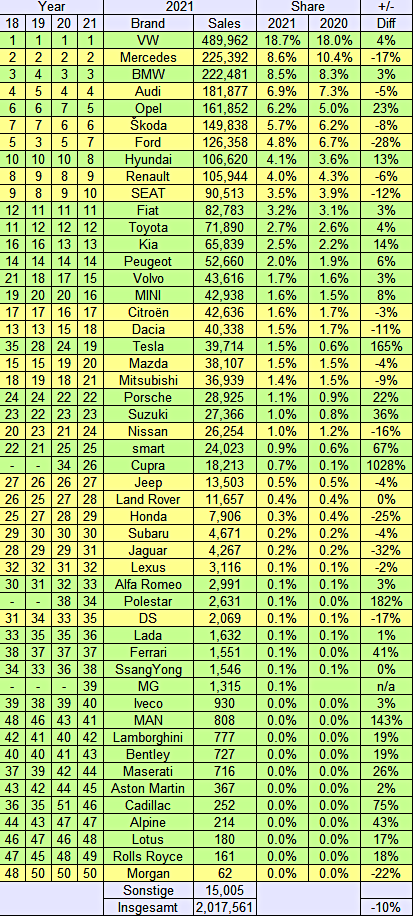
Germany Sales : 2021


Registrations for December were -27% and -10% for the whole year. In other words, a poor sales performance. In 2019 3.6 million cars were sold, this year 2.6 million. The '+/-' column below is comparing market share variance for 2021 with 2020. 

VW extended its lead, with BMW close to overtaking Mercedes-Benz for second place. Opel has had a strong year, led by the Corsa and got quite close to overtaking Audi. Maybe in 2022. Cupra is just the Formentor and Born models as they are not officially separated in the SEAT data so it's probably a little low. Renault and SEAT can't decide who should go first. Hyundai got tired of that and pushed past them.  

Point of interest: In a word 'Others' or as they say in Germany 'Sonstige'. Why is it so high? There must be many missing brands from the list below. This brings me to MG. KBA showed monthly MG sales for November and December but unusually didn't total them accumulatively as it does with all others.

MG started selling cars in Germany early in 2021 but didn't at first appear on the registrations. They did for the last two months but as the total figure for the year would be incomplete, they stood as monthly sales only. I've put the two month's MG data in the chart below but it must be lower than what it should be. That still leaves many sales unaccounted for, even allowing for MG's shortfall.

Data source: KBA.

24 October 2021

Opel & Ford Germany : 1977-2021


Opel and Ford were brands that invested heavily in Germany and both sold well there. For many years they were second and third best selling brands behind VW. Occasionally Mercedes got past Ford into third but would fall back again. In the UK Ford always outsold Vauxhall (Opel) but in Germany, it was the other way around. 

The chart immediately below shows market share and goes up to 20%. The graph covers from 1977 to 1999 and Opel (red) was consistently in the ascendency compared to Ford (blue). What you can't see below is that Mercedes passed Ford again in 1998 and apart from one lapse in 2009, stayed ahead of Ford until today. 

In fact, we can see that toward the end of the graph both Opel and Ford were declining in market share in the country which raises the question as to whether that slide was to be arrested.


Below we see from 2000 to 2021 on a larger scale of 12% share so don't compare the two graphs by physical size but by the percentage numbers on the sides. 

Ford leveled off from 2000 and held its share consistently. Opel's decline continued to 2012 when there was a slight uplift. By 2012 they had both been pushed back by Mercedes, BMW and Audi to fifth and sixth. Apart from a brief moment for Ford in 2019, neither have since matched the three marques that had passed them.

Ford overtook Opel in 2017 and in that same year, Opel was acquired by PSA. Ford then had a mini surge to 2019 then suddenly a change of policy has sent Ford plunging to seventh place by 2021. Opel was seventh in 2020 but is back up to fifth for 2021 in a possible revival of fortunes. 


So what do we learn from all of this? That mainstream manufacturers in have a lot of competition and they have to carefully guard their reputation by offering a strong, consistent product range. 

Opel lost its reputation as a top notch mainstream brand and ended up chasing volume to keep factories busy, but in the process became unprofitable. PSA is working hard to turn that around, focusing on product. That is showing signs of success but it's not a quick fix. 

Ford has done better in regard to maintaining a competitive range but is now following a global strategy of moving away from passenger cars, which will impact on the number of units sold. It needs a strong SUV / crossover range if that is all its passenger car range will be comprised of. 

Much is resting on models such as this for Ford


14 February 2021

Germany Premium Marque Sales Graph : 2000-2020


It doesn't take profound powers of observation to notice the strong leaning for German branded premium cars. In fact, Lexus was left out altogether as it barely registered as an intermittent line along the bottom rung of the graph. At least Volvo and JLR do get some recognition, albeit scant. 

Back in the year 2000, Mercedes (red) was well ahead but it steadily declined. The MINI enabled BMW to pull away from Audi and strive to assert itself as the top dog. That battle is still being won by Mercedes but only just. Any pretensions Audi had to join the tussle seem to be fading for now at least.

Which leave Volvo and JLR to meander along, effectively like bottom feeders in a deep pond.    


15 January 2021

Germany Premium Comparison : 2018-20

As rare as the proverbial hen's teeth on German roads.  

The three main premium marques here take over 82% of the market, 87% if MINI is included. Porsche then takes it up to 90%. So no prejudiced buying here then. The rest feed off crumbs that fall from the dining table. Volvo has cracked the 5% barrier but has it hit a glass ceiling? Tesla execs must be in a lather at the prospect of reaching the 2% mark! At least buying local keeps the money within the country. 

Data source: KBA.

12 January 2021

Germany Top 50 Models : 2020

If the German car buyer wants a small hatch, it has to almost always be a VW Golf. 136,000 examples found buyers and that was after a drop in sales by a third. Anyway, after daylight comes the Passat (+3%) and Tiguan (-31%). The Golf's main competition - the Ford Focus - almost sold the same number than a year before, but that was still far short of the VW.

The Renault Zoe had a stellar year (+222%) although the take up of electric cars has been slow in the country. I suppose blasting down an autobahn isn't the best way to beat range anxiety. 

Data source: KBA.

Germany Car Sales : 2020


The total of 2,917,000 for 2020 just exceeded the previous low of 2010 by a mere thousand units. The next time the total was lower was way back in 1989. Can 2021 deliver a reversal of fortunes?

Registrations were up 10% in December, softening the YTD figure of -19%. The country has carefully tried to balance the Covid outbreak with keeping commerce functioning. Therefore, the end result is a good one although 2021 is already proving challenging with another virus flare-up.

Despite limiting the damage as best possible, few brands were able to increase sales (green, below). Fiat managed to break even and Tesla made a somewhat belated impact on the German car scene. Like other markets the SEAT spin-off Cupra and Volvo's Polestar are new entries that will be watched with some interest.

Data source: KBA.

05 October 2020

Germany Pick Up Sales : 2015-19

Mercedes took on the pick-up class but
found it tougher than expected

While this category isn't big in Germany, it is growing. The list is as best as I can get but the way the data is presented by the KBA, it isn't possible to get it 100%. It's close though, or I wouldn't waste everyone's time publishing it. A few models are not here, but they would sell in small quantities anyway.

The Ford Ranger has been top for some time now and continues to pull away. No wonder the next Amarok will be Ford Ranger based, a deal VW will be pleased to have done. Mercedes came third but in its home market with a parochial buying public, being so far behind the Ranger was a sobering result.


Germany Pick-Up Sales

Make Model 2019 2018 2017 2016 2015

Ford Ranger 10,102 7,988 8,503 6,717 5,678

VW Amarok 4,559 3,943 4,130 3,584 4,501

Mercedes X-Class 3,257 3,056 538 - -

Nissan Navara 3,091 2,994 3,588 4,049 2,670

Mitsubishi Triton 2,093 1,820 2,128 1,691 1,869

Toyota Hilux 1,951 1,673 1,869 2,204 1,568

Isuzu D-Max 687 746 905 978 871

Fiat Fullback 326 811 921 438 -

Renault Alaskan 264 459 119 - -

SsangYong Musso 141 191 110 147 133

For more on pick-ups, try these if you wish.

2019: Australia/New Zealand/South Africa 

2015-19: Belgium Denmark France Iceland Italy Sweden United Kingdom

Argentina Brazil Indonesia Thailand

2015: World Top 50

16 September 2020

Snapshot: Germany 2000

Third overall and top selling premium model

We go back in time to the beginning of the century. Below are sales by all the main brands, the 60 best selling models and a bonus section of the 20 best selling premium models. The data comes from the KBA and is of a high standard. I decided to put Opel as a German brand as it started that way and the name reflects that.

Brands: German brands not only were at the top but were strong in volume too. Renault was the  brands, unsurprising back then but different from today. Apart from Ford Europe (which has strong links to the country anyway) only Renault was anywhere near them.

Models: Again local brands to the fore, with only the Ford Focus offering much resistance. As it was made in Germany, it shows the awareness of what is locally made and the support such are given. Germany had 20 models on the list of 60, the rest of  Europe 20, Japan provided 10 and the USA 5.

Premium: This information is not included in the figures I've been mentioning above. It is where European marques are totally in the ascendancy. The BMW 3-Series was the most sought after.


Brand Model
1 VW 643,615 Europe 1 VW Golf / Jetta 317,948
2 Opel 411,574 Brands 2 Opel Astra 157,936
3 Mercedes 409,214 17 3 BMW 3-Series 147,613
4 Ford 238,517 Models 4 Mercedes C-Class 115,761
5 BMW 237,750 20 5 VW Passat 102,659
6 Audi 234,404
6 Ford Focus 101,594
7 Renault 200,361 Germany 7 VW Polo 94,874
8 Peugeot 100,348 Brands 8 Mercedes A-Class 94,751
9 Fiat 98,478 6 9 Opel Corsa 93,159
10 Toyota 86,794 Models 10 Mercedes E-Class 87,234
11 Mazda 76,701 25 11 Audi A4 80,264
12 Nissan 74,678
12 BMW 5-Series 67,039
13 Škoda 68,756 Japan 13 Audi A6 65,243
14 Seat 60,813 Brands 14 Opel Vectra 57,732
15 Citroën 50,108 9 15 Opel Zafira 56,412
16 Mitsubishi 48,606 Models 16 Audi A3 52,614
17 smart 48,054 10 17 Fiat Punto 49,862
18 Volvo 41,563
18 VW Lupo 49,462
19 Honda 33,536 USA 19 Peugeot 206 48,099
20 Hyundai 28,442 Brands 20 smart ForTwo 48,054
21 Suzuki 23,036 3 21 Renault Scénic 42,888
22 Chrysler 22,483 Models 22 Renault Twingo 42,529
23 Kia 19,658 5 23 Ford Fiesta 39,556
24 Alfa Rom 18,635
24 Škoda Octavia 39,260
25 MG Rover 14,005 Korea 25 VW Transporter 37,003
26 Daihatsu 12,714 Brands 26 Renault Mégane 32,979
27 Land Rover 11,950 4 27 Ford Ka 31,586
28 Porsche 11,719 Models 28 Renault Clio 31,086
29 Daewoo 11,295 0 29 Ford Mondeo 30,692
30 Subaru 9,703
30 Mercedes CLK 29,390
31 Lancia 8,105
31 VW Sharan 24,716
32 Saab 7,489
32 Opel Omega 24,579
33 Jaguar 6,432
33 Volvo 80/70 Series 23,291
34 GM US 3,064
34 SEAT León / Toledo 21,685
35 Lexus 2,284
35 SEAT IbizaCórdoba 21,391
36 Ferrari 630
36 Mercedes S-Class 21,266
37 Maserati 539
37 Mercedes SLK 21,001
38 Ssangyong 516
38 Mazda 6 20,987
39 Isuzu 515
39 Nissan Almera 20,835
Premium 40 Toyota Corolla 20,411
1 BMW 3-Series 147,613 41 Audi TT 20,309
2 Mercedes C-Class 115,761 42 Mazda 3 20,203
3 Mercedes A-Class 94,751 43 Nissan Primera 20,195
4 Mercedes E-Class 87,234 44 Renault Kangoo 19,353
5 Audi A4 80,264 45 Toyota Yaris 19,056
6 BMW 5-Series 67,039 46 Peugeot 406 19,047
7 Audi A6 65,243 47 Renault Laguna 18,816
8 Audi A3 52,614 48 Škoda Fabia 18,427
9 Mercedes CLK 29,390 49 Toyota Avensis 18,310
10 Volvo 80/70 Ser 23,291 50 Citroën Xsara 18,061
11 Mercedes S-Class 21,266 51 Ford Galaxy 17,937
12 Mercedes SLK 21,001 52 Volvo 40/50 Series 16,848
13 Audi TT 20,309 53 Peugeot 307 16,256
14 Volvo 40/50 Ser 16,848 54 Nissan Micra 16,107
15 Mercedes ML 14,728 55 Mercedes ML 14,728
16 Alfa Rom 156 12,061 56 Citroën Berlingo 14,208
17 Audi A2 10,045 57 Mercedes Viano/Vito 13,825
18 BMW Z3 9,390 58 Mazda Premacy 13,584
19 BMW 7-Series 8,097 59 Fiat Seiciento 13,487
20 Land Rover Freeland 7,055 60 Honda Civic 13,204