Showing posts with label Nation - Sweden. Show all posts

06 January 2026

Sweden Top 50 Models: 2025


Passenger car registrations were 272,987 (+1.3%), with 36.5% electric and 26.7% plug in hybrids. That is 63.2% of the total, the highest share ever. Seeing as electric cars sell strongly here, it is noticable that Chinese models are absent. I assume Swedes are cautious about unfamiliar brands. 

Looking at the chart below, colour coding helps to identify where the various models hail from. Europe is the predominant source for cars, with a few Japanese and Korean models. 

Volvo and VW are the two most popular brands and they feature toward the top end of the Top 50 list. Toyota and Kia have some success here. The Tesla Y has spectacularly dropped 68% but still managed 4th place.

Data source: Mobility Sweden.

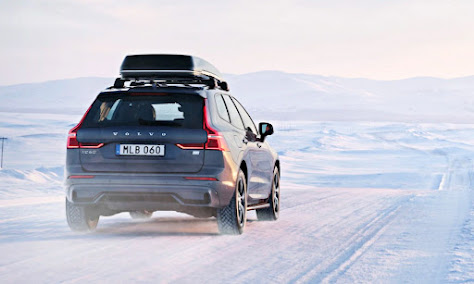
Photo source: Volvo (XC60) & VW (ID.7).

04 January 2026

Sweden Passenger Car Sales : 2025


Registrations were up 1.3% for 2025. 2024 was a poor year compared to recent history, so 2025 is another one. Volvo has always been the best selling marque and will be staying there. Market share (ms) was up 3% and its 17.9% share is the highest since 2020. Plenty of loyalty on display here.

VW ms is up an impressive 31% and Toyota managed a 5% gain. Subaru is a really odd case. In January 2025 it sold 2,580 for a 640% increase yoy. Since then, it sold a mere 479 cars. A February surge in ethanol fuel tax was the reason.

Tesla was down 67% and I assume it wasn't just market forces that was behind it. I wonder if this is a backlash for trade issues with the EU. Škoda was up 24%, Polestar and Cupra both up 29%  with the Tavascan and Terramar the main reason for the upturn. MG and Citroën are going the other way, down 48& & 34% respectively. 

For 2024 articles, simply click on the links below:

Data source: Mobility Sweden. Picture Source: Volvo & Škoda Sverige.


04 January 2025

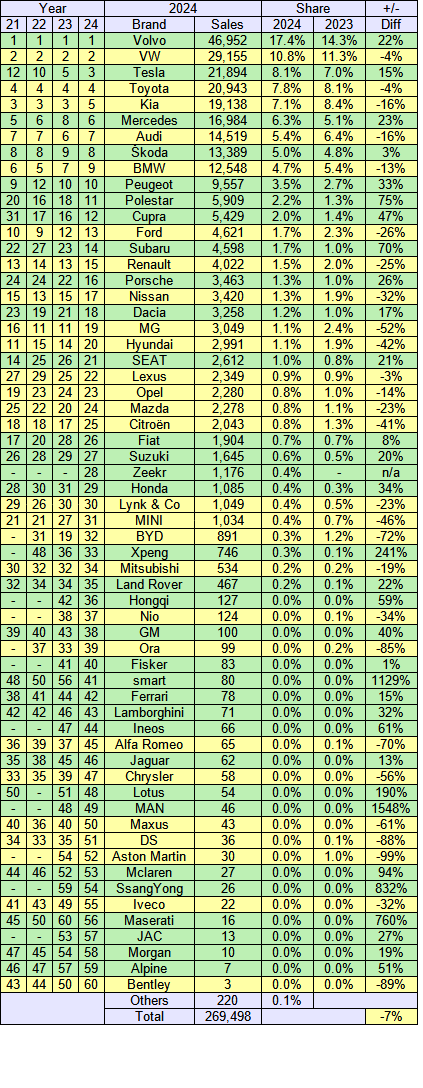
Sweden Passenger Car Sales : 2024


Registrations were down 11% in December and minus 7% for the complete year. Volvo's market share of 17.4% is the best since 2020 which is an amazing number considering they are a premium brand with a somewhat limited range of cars. Local support at its best. 


Sweden's a place where things move around fluidly so change is very much the norm. A few years back, I thought that VW would eventually overtake Volvo as it closed the gap between them but that's an unlikely outcome as the gap now substantially widens. 

Tesla is up to third and Toyota has passed Kia for fourth spot. Mercedes-Benz has come back after slipping for a few years. Chinese brands have arrived and their electric cars are proving to be quite popular. All these new brand are making it a long list.

Data source: Mobility Sweden.

03 January 2025

Sweden Top 50 Sales : 2023-24


Sweden like many other places is pushing for lower carbon dioxide emissions but in 2024, there was a slight increase in them. Electric car registrations fell 16% despite the Tesla Y doing well. These things will ebb and flow to a certain extent depending on many factors that will influence car buyers.  

Volvo didn't take the top spot but they did secure the next four places and Volvo's dedicated electric brand Polestar also made the top ten. 

The list is colour coded to show country/region of origin. Europe is the main supplier of cars with a reasonable smattering of Asian brands. Interestingly, Kia does well here but no Hyundai models make the top 50 or get anywhere near it. I must say I prefer Kia of the two. 

Data source: Mobility Sweden. Picture source: Volvo.

03 January 2024

Sweden Top 50 Sales : 2023


Tesla has done something rarely done, bumped a Volvo model off the top spot. The VW Golf managed it in the year 2016 but throughout the 21st century, that was the only time. The home town hero took second and fourth, the combined ID4 and 5 in between them. 

European brands are the most common in this list but Asian ones are strong toward the top of the list. Electric cars are expected to slip in 2024 as consumers constantly need incentive schemes to compensate for the higher purchase price. If so, the list may be in for a shake up.  

Data source: Mobility Sweden.

Sweden Passenger Car Sales : 2023


Registrations for December were down 17% and barely managed to get into positive territory with a 1% gain for the year. Delayed deliveries for vehicles were finally being met earlier in the year hence the weaker end to the year. 

Electric cars amounted to 39% of the market and plug in hybrids 21% which combines to just under 60%. 2024 is expected to see a fall in that percentage share with private sector take up softening despite strong business sales. This is due to the ending of a climate bonus scheme, which encouraged private buyers toward electric cars of some sort. 

The 'Diff' column shows market share change which would also reflect whether registrations were up or down in volume. Volvo remains well ahead of the rest despite being down. VW and Kia were also down but Toyota improved its share ever so slightly. Tesla impressed with its move into the top five. Chinese brands are now appearing in ever greater numbers. 

Cupra's 2022 figure is not a full one, with some sales falling under SEAT. The 2023 is much closer but may be a tad low too. The issue will be sorted out in 2024. 

Data Source: Mobility Sweden.

04 January 2023

Sweden Top 50 Sales By Model : 2022

Below are the top selling models in Sweden. Volvo has three of the top five with Tesla pushing into the top ten with the Model Y. 

The colour coding below shows the region where a brand is associated, not where the model is made or from which country the owner of that brand is situated. 

03 January 2023

Sweden Sales : 2022


Registrations for December were up 28% but that couldn't stop the full year from being down, -4%. The '+/- diff' column below is for market share change.  Volvo remains top and gained a little on VW. Considering the volatile conditions facing the car industry, the top brands were surprisingly stable compared to 2021.

Newbies from China did well. MG is in its second year and already is a whisker away from a top ten spot. Lynk is also looking solid while new entrants BYD and Ora did extremely well in their inaugural year. In the Māori language, ora means healthy, matching the registrations of the Ora car brand nicely.  

As for new Euro marques, Volvo spin off Polestar is already in a starring role, and SEATS equivalent is trouncing its donor brand. 

Data source: Bilsweden.

05 January 2022

Sweden Top 50 Sales By Model : 2021

"I'm sure there is a charging point around here somewhere"


It quickly becomes apparent that the models that are succeeding in Sweden have some sort of electrical propulsion. Government incentives are attracting punters like fruit flies to vinegar. I don't know how the charging infrastructure is in rural areas but I assume it's pretty good. 

I colour coded the list to show where brands historically originated. Europe is the predominant region as one would expect. Whether sales went up or down is revealed in the '+/-' column. No surprise with the top three placings but Kia taking the next two is an interesting development. 

Point of note: While the detail provided by Bilsweden regarding model sales is impressive, it does have a couple of notable exceptions. A total of 777 Volvo sales are not allocated to any model. Admittedly, that is less than 2% of the total but hard to fathom. As for Lexus, over half of its sales are not assigned.  

Data source: Bilsweden.

04 January 2022

Sweden Sales : 2021


Registrations for December were -20% but +3% YTD. A change in an incentive policy (downward) for hybrid cars from the 1st of April and an increase of incentive for full electric cars has created some volatility with brands affected by the change. 

The semiconductor shortage hasn't helped in almost eroding all the registration gains made earlier in the year. In the end sales did not get near pre-covid numbers, being about 50,000 units short once 2021 had bade farewell. 

The '+/-' column below is comparing market share variance for 2021 with 2020. Volvo is still the best-selling brand here, with VW losing more registrations than Volvo managed. VW had been closing in slowly year by year but for now at least, a reversal. 

There is a sizable drop back to Kia and Toyota at third and fourth respectively but they have closed the gap to some extent during 2021. MG is moving on up, not surprising considering the increased incentives on offer. Volvo's Polestar electric brand is still improving while the Geely owned Lynk & Co (Volvo's owner also) started quite strongly. The 01 model it's selling has much in common with the Volvo XC40. 

Point of interest: Volvo has been the top selling brand every year since 1958. How has Volvo managed to do that? It must be due in no small measure to local support for a company that adds much to the economy. Even though now it is foreign owned, it is still a valuable contributor. It makes sense to support local manufacturing regardless of who owns it and Swedes get that. I can think of only one exception to that (in another country). 

Data source: Bilsweden.

08 January 2021

Sweden Premium Comparison : 2020


Premium sales were -16.5% for 2020, slightly better than the overall total. Local hero Volvo maintained its top spot with ease but its share has fallen from 51% two years ago to 44%. I assume its part of a strategy to improve margins. 

BMW is behind Mercedes and Audi as a stand alone marque but with MINI, is still comfortably ahead. Like other places, both Jaguar and Alfa Romeo had a poor 2020. The new Polestar marque from Volvo is a new addition and came in at 7th, a strong start. 

Data source: Bilsweden.

07 January 2021

Sweden Top 50 Models : 2020

With Volvo registrations -42% in December, it wasn't a great finish for the marque. Still, they took the top three placings thanks to the XC40 doing well and the VW Golf not. Kia had a very strong December, with a 25% increase in a market -29%, the Niro and Cee'd in fine form. The Toyota RAV4 was up nearly 250% in December, helping push it up from 17th to 9th. 

Electric and hybrid models made gains so any model offering such did well. If a car still relies on ICE propulsion alone will be increasingly marginalised in Europe.  

Data source: Bilsweden.

06 January 2021

Sweden Car Sales : 2020

Land Rover are doing OK in Sweden

Registrations were -29% in December and -18% YTD. The YTD figure is quite good but not so much December, in part reflective of a strong December last year. The 291,600 sales were over 64,000 down on 2019 and the lowest total since 2013.

Electric and Hybrid passenger cars increased 132% in 2020, 94,000 units the final result. The share these vehicles took went from 11% to 32%. For now, hybrids are increasing faster than full electric cars. The arrival of Volvo's Polestar electric brand had an immediate reaction, with over 1,640 registrations already. The Kabe Husbil is a motorhome so I'm not sure why it's included under passenger cars. Maybe that happens for other brands as well but not in a way it can be detected. 

A definite shift toward the larger selling brands is evident here. Kia and Toyota were about the same as last year while further down, Citroën, Porsche and Land Rover held up well. Renault, Ford, Nissan and Mitsubishi are noticeable for the opposite reason. 

Data source: Bilsweden.

24 May 2020

Sweden Pick Up Sales : 2015-19

This is a typical pick-up line in Sweden

Just when I thought pick-up sales around Europe followed a pattern, along comes Sweden. VW usually follows in the wake of Ford and Japanese brands but here it has a clear lead. The Ranger is generally top in this region but is fourth. What is the same is the three at the bottom.

If the three derived from the Nissan Navara are combined, collectively they do very well. The Fullback added to the Triton also lifted it out of the also-ran category briefly. What it does show is that brands using the same basic model didn't canabalise sales off each other.


Sweden Pick-Up Sales

Make Model 2019 2018 2017 2016 2015

VW Amarok 2,234 2,213 2,612 1,764 1,794

Nissan Navara 1,533 1,658 1,453 1,609 1,118

Toyota Hilux 1,475 1,430 1,390 1,338 1,154

Ford Ranger 1,242 1,582 1,470 1,350 1,158

Isuzu D-Max 670 679 563 591 458

Mitsubishi Triton 622 794 910 934 902

Mercedes X-Class 600 857 129 - -

Renault Alaskan 161 317 98 - -

Fiat Fullback 95 322 308 130 -

Data source: Bilsweden.

For more on pick-ups, try these if you wish.

2019: Australia/New Zealand/South Africa 

2015-19: Belgium Denmark France Iceland Italy Sweden United Kingdom

Argentina Brazil Indonesia Thailand

2015: World Top 50

30 January 2020

Sweden Top 4 Brands : 2010-19


The past decade has seen the same two marques at one and two. How different to when the series started back in the 1950-59 decade when positions changed regularly. At last third and fourth has been more keenly contested. It was Toyota and Audi in a stoush early on, the latter retreated with a blood nose. Then Kia came into the frame, took on the Big T and for now is winning.

A the sun sets on the past ten years, local loyalty has shone through. Toyota hasn't been able to close the gap on VW, perhaps Kia can do so. Maybe the car market is a bit too affluent here for that to happen.

Year 1st 2nd 3rd 4th
2010 Volvo 53,718 VW 35,692 Toyota 21,628 Ford 17,856
2011 Volvo 58,862 VW 43,492 Audi 18,872 Ford 16,954
2012 Volvo 52,800 VW 42,732 Audi 17,082 Toyota 16,608
2013 Volvo 53,939 VW 39,393 Audi 17,238 Toyota 17,202
2014 Volvo 61,496 VW 44,948 Toyota 19,338 Audi 18,613
2015 Volvo 71,221 VW 51,913 Toyota 20,508 Audi 20,463
2016 Volvo 71,238 VW 57,823 Audi 22,662 Toyota 22,332
2017 Volvo 75,506 VW 57,450 Toyota 23,076 Kia 23,037
2018 Volvo 69,943 VW 53,471 Kia 23,045 Toyota 21,795
2019 Volvo 65,273 VW 48,927 Kia 25,453 Toyota 22,879

Data source: Thanks to BilSweden.
For others in the series, please click on the years: 2000-09, 1990-99, 1980-89,
1970-79, 1960-69, and 1950-59.


16 February 2017

Sweden Premium Comparison : 2010-16

Premium cars are proving popular in many nations. They are often outselling cheaper mainstream brand while at the same time making more profit. More recently the most aggressive attack on this segment have been the BAM marques, BMW, Audi and Mercedes Benz. However other car makers are striking back and the competition is heating up. So a look at sales in this decade would be interesting.

First taking the BAM brands out of the equation, how are things shaping up in Sweden? From 2010 to 2016, other premium sales were up 38%. Now individually: Porsche +180%, JLR +139% (LR +130% Jag 156%) Lexus +100% Volvo +33% Alfa Romeo -1% and Cadillac on the periphery.

Year 2016 2015 2014 2013 2012 2011 2010
Total 77,065 76,379 65,046 56,477 55,262 61,756 56,043
Volvo 71,238 71,221 61,496 53,939 52,800 58,862 53,718
Lexus 1,644 1,532 1,025 717 720 993 821
JLR 1,459 1,219 1,256 1,031 938 856 610
Land Rover 907 985 1,079 832 822 639 394
Jaguar 552 234 177 199 116 217 216
Porsche 1,335 1,215 819 554 522 490 477
Tesla 1,125 996 266 - - - -
Alfa Romeo 208 125 175 230 271 542 210
Cadillac 56 71 9 6 11 13 207

Summary: Porsche, Jaguar, Land Rover and Lexus but only Volvo has any real volume of the brands involved in this section.

                                                 *******************

Now adding the other brands to the BAM marques, how do things stack up? Total sales growth goes to 45%, due to the BAM brands increasing 56%. The 'Others' took 57.5% in 2010 and 54% in 2016. The BAM marques took 46% of all premium sales in 2016.

Year 2016 2015 2014 2013 2012 2011 2010
Total 141,624 133,342 114,965 100,481 101,332 109,940 97,397
Others 77,065 76,379 65,046 56,477 55,262 61,756 56,043
BMW Group 24,914 22,479 19,771 17,552 17,580 17,451 14,709
BMW 22,146 19,684 18,125 16,192 16,088 16,036 13,959
Mini 2,768 2,795 1,646 1,360 1,492 1,415 750
Audi 22,662 20,463 18,613 17,238 17,082 18,872 16,170
Mercedes 16,983 14,021 11,535 9,214 11,408 11,861 10,475

Summary: The BAM trio have to play second fiddle to Volvo in Sweden. In fact, Volvo outsells all other premium brands combined! The BMW Group has overtaken Audi to lead the BAM Marquez. The three biggest in 2016 were 1) Volvo, 2) BMW & Mini, 3) Audi.

Data source: Bilsweden.
Text source: RayCee.