Showing posts with label Brand - Ford. Show all posts

08 June 2026

Ford Mustang Yearly Production Numbers (1964-2025)


The Ford Mustang is an icon of the automotive industry, well in the USA anyway. Most of them were sold there after all. It created the 'pony car', an affordable compact muscle sports car. 

Sales took off and a star was born. Many Mustang buyers graduated onto other Ford models so it had that additional benefit as well.

Unfortunately, subsequent models got bigger and heavier - as car executives cannot resist doing - and the Mustang production slipped slowly but inexorably down. New models gave the Mustang a pep but each time a little less so. Still, it was worth the continuation.

Its main competitor was the Chevrolet Camaro, which did well but couldn't quite match the Mustang for sales. Both have sold well, so the muscle car is a popular model even if not as much today as times past. To see the Chev Camaro production history, just click here.

Below the colours are for each series, six so far. The decade figure defines the end of such in a '0' year. Each period has seen a reduction in production volume. Exports have included right hand drive recently and I see them around the roads in New Zealand, where the Mustang is proving popular.

Generation Seven:

The 7th generation arrived in 2023 but I have put the  6th generation for that year. What stands out is the lower volume for the 7th generation. Why?

Higher prices plus the fact that it has a similar chassis and appearance to the previous generation are cited as the main reasons. Many are opting to buy late model 6th generation cars instead. 

The fact that production is at an all time low and yet Ford persists with the Mustang is a good sign. It's a car few now buy but it offers something unique. Ford is now unchallenged in the standard V8 muscle car market. 

Clearly it's a market segment in decline and if that continues, one would have to wonder of an 8th generation will see the light of day. Apparently, Ford will be doing it, around 2029. 

Last updated 08.06.2026. 

23 December 2025

Electric Vehicles Proving Expensive


When I say proving expensive, I'm refering to some manufacturers in this instance. In particular Ford and the F-150 Lightning. If the name Lightning implied that would be selling fast, then that would be a misnomer. 

Sales were suggested to be in the 150,000 region per annum. They peaked at 33,500 in 2024 and over the four years it's been on sale, barely got past a combined total of 100,000. The scrapping of federal EV tax credits may have been the final nail in the coffin, but maybe it was doomed regardless. 

The amazing thing is it was the best selling BEV truck in the US. Mind you, the Cybertruck wasn't exactly competition, just a little opposition. Still there are others out there and they were beaten too. Despite that, Ford has decided to end the Lighning. 

So this u-turn is costing the company billions of dollars, according to Ford. From the outset, I never saw BEVs as an ideal mass market vehicle, more likely to carve out a niche. Surely, fuel cell or synthetic fuels have potential for broader mass appeal. 

Some markets see it differently and are pushing BEVs to become the future of mobility, for now at least. One positive is they are providing some stability by not flip flopping. What it shows is that predicting the future is as difficult as it has ever been. Those that are putting a great deal of money into BEVs are taking a risk and already some have been burned. Electric vehicles sure can be expensive. 

20 January 2025

Ford / Lincoln US Model Sales : 2023/24


There are two makes that comprise Ford USA. Ford's 'bread 'n butter' brand accounts for 95% of sales and the premium Lincoln marque just 5%. 

Ford: Sales were up 3% YTD, just short of two million units finding new private homes or corporate parking lots. 

All of this done with virtually no sedan passenger cars. The Mustang would be the only one and that represents less than 3% of the total. 

The F-Series pick up commands 39% of the total, an amazing figure but a long standing one. The Maverick pick up (picture above) was up 39% so proving a successful model for Ford. 

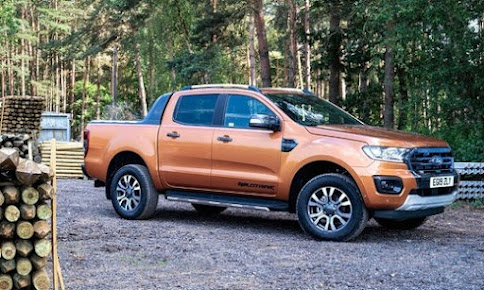
The Ranger is a slightly larger size compared to the Maverick but dearer and not selling anywhere near as well. Still, it increased 43%.

The Transit van was up 18% to 153,000 sales but the Transit Connect was down 51% to 8,800 and on the way out. The E-Series light truck was up slightly. 


Lincoln:
One of the success stories of 2024, perhaps the success story. All the models increased (bar the big Navigator SUV) which gave the marque a 28% overall gain. They achieved 50, 12 and 62% growth respectively for the top three models of the range.

Lincoln is without a sedan but that is not a surprise these days. The Nautilus is pictured above. The sales increase by Lincoln certainly has the mercury rising. 

18 June 2022

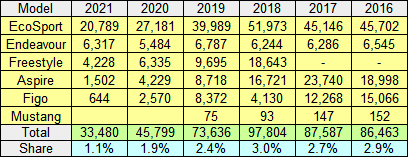
Ford India Model Sales : 2016-21

Ford was doing what so many other manufacturers have been doing, trying to make a business case for manufacturing and selling in India. Hovering just below the 3% mark wasn't good enough but little was changing despite little in the way of new models.

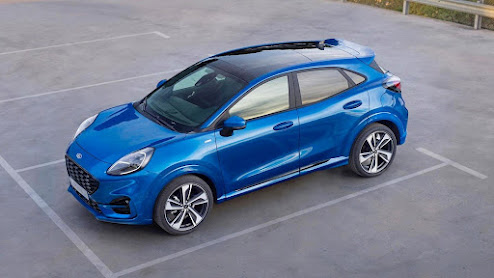
2018: One newby was the Freestyle (picture above), a crossover variant of the Figo. I would assume it was a cost effective model and sales were OK for the year but not the next. 

2021: It's operation ran up losses in excess of $2 billion dollars in the previous decade! Ford has therefore decided to end sales in the country but for now still exports. There is worker unrest over Ford's decision to end production by the end of 2022. It it still has two plants there, one of these will probably be sold to Tata, which will make the exit slightly more palatable. 

17 June 2022

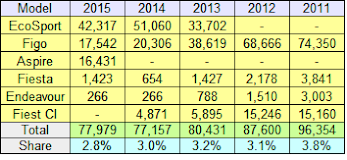
Ford India Model Sales : 2011-15

In recent times, Ford started selling cars in India in 1997. From there it rarely reached even a 2% share. Could they ever make a real go of penetrating this market? Let's have a look.

Market share jumped from 1.6% in 2010 to 3.5% in 2011 with the arrival of the compact Figo hatchback. It looked similar to but was small than the Fiesta Classic that was sold alongside it. A good start. 

2011: Now sales were close to 4% of the total although so many eggs in the Figo basket wasn't ideal. 2012 held up pretty well with nothing new released.

2013: In came the small EcoSport crossover (picture on right), which did well in a country that mainly buys tiny cars. Unfortunately, the Figo was already falling out of favour so all the Ecosport  did was help retain the status quo. At least a new Figo was coming.

2015: The Fiesta Classic finished its run in 2015 and a new generation Figo was released, the Aspire being the 4-door version. It was based on the Ka but sales show it didn't go that well. A new model should lift volume. Things weren't looking so rosy for Ford in India. Would they continue or leave?

19 February 2022

Romania Car Production : 2015-21


Romania has two manufacturers of cars, Dacia and Ford. The volume has been steady over the past several years, with Dacia down slightly and Ford up. For a country that needs employment, the industry will be a great help to the economy.  

Dacia: Since 1968 the Mioveni plant has produced Dacias starting with the 1100 model. Initially, older models from Renault were made and with the take over by Renault they became uniquely styled budget cars. Since the Duster's launch in 2010, 2 million have been made. 

In January 2022 the seven millionth car rolled off the assembly line, a Duster. Something like 85% of production is exported, as you would imagine for a country of this size. The total Dacia figure for 2021 is accurate but individual models are estimates. 


Ford: The company took over the Daewoo Craiova plant and in 2008 commenced assembly of Transit vans. In December 2021, the one millionth car was assembled, a Puma. The Puma and Ecosport models are currently made here, with a new light commercial model to be added in 2023. Below the totals are accurate but the model breakdown for the past two years are estimates. 

31 January 2022

Ford European PC/LCV Model Sales : 2020-21


Ford is in the process on giving up on the traditional car while concentrating on the new categories and light commercial vehicles. This is based on focusing on more profitable segments. While I get the strategy, I wonder why others are not queueing up behind to do the same. Maybe they are well ahead of the competition on this one. 

To see the effect, vans hold first and fourth placings and crossovers second and third. The two mainstays of Ford Europe (Fiesta and Focus) both dropped substantially with Fiesta sales during the fourth quarter almost nonexistent. 

The Ranger pickup continues to perform well in a region where such vehicles aren't that common. It commands 31% of the segment in Europe. The oddly named Mustang Mach-E is doing well too. 

Data source: Ford.

The five largest markets for Ford in Europe are listed below. Germany is the biggest overall but not for the Blue Oval. The UK has that distinction and now by a substantial margin.  


24 October 2021

Opel & Ford Germany : 1977-2021


Opel and Ford were brands that invested heavily in Germany and both sold well there. For many years they were second and third best selling brands behind VW. Occasionally Mercedes got past Ford into third but would fall back again. In the UK Ford always outsold Vauxhall (Opel) but in Germany, it was the other way around. 

The chart immediately below shows market share and goes up to 20%. The graph covers from 1977 to 1999 and Opel (red) was consistently in the ascendency compared to Ford (blue). What you can't see below is that Mercedes passed Ford again in 1998 and apart from one lapse in 2009, stayed ahead of Ford until today. 

In fact, we can see that toward the end of the graph both Opel and Ford were declining in market share in the country which raises the question as to whether that slide was to be arrested.


Below we see from 2000 to 2021 on a larger scale of 12% share so don't compare the two graphs by physical size but by the percentage numbers on the sides. 

Ford leveled off from 2000 and held its share consistently. Opel's decline continued to 2012 when there was a slight uplift. By 2012 they had both been pushed back by Mercedes, BMW and Audi to fifth and sixth. Apart from a brief moment for Ford in 2019, neither have since matched the three marques that had passed them.

Ford overtook Opel in 2017 and in that same year, Opel was acquired by PSA. Ford then had a mini surge to 2019 then suddenly a change of policy has sent Ford plunging to seventh place by 2021. Opel was seventh in 2020 but is back up to fifth for 2021 in a possible revival of fortunes. 


So what do we learn from all of this? That mainstream manufacturers in have a lot of competition and they have to carefully guard their reputation by offering a strong, consistent product range. 

Opel lost its reputation as a top notch mainstream brand and ended up chasing volume to keep factories busy, but in the process became unprofitable. PSA is working hard to turn that around, focusing on product. That is showing signs of success but it's not a quick fix. 

Ford has done better in regard to maintaining a competitive range but is now following a global strategy of moving away from passenger cars, which will impact on the number of units sold. It needs a strong SUV / crossover range if that is all its passenger car range will be comprised of. 

Much is resting on models such as this for Ford


27 August 2021

UK Ford / VW Brand Comparison : 2009-2021

The Ford Puma crossover is selling well


Ford has always been a firm favourite in the UK and the best selling nameplate for decades. Is that about to end? it appears so as Ford registrations fall not only in the UK but across Europe. I call it a repositioning of the company, moving away from low margin cars to SUVs and light commercial vehicles. In doing so, volume has to be affected. The graph below shows that as recently as 2015, Ford was selling strongly but since then a marked slide in units sold occurred. 

So who will take over the mantle of best selling brand? It pains me to say VW, a brand that fought against any compensation for duped owners in the UK. The fact the UK government was too indifferent to act is not the point. VW paid US owners without a legal fight but must have (understandably) thought the UK legal system was a soft touch like the government. 

VW claimed after being caught they were changing the culture of the company. After its appeal in the UK against paying any compensation was rejected, the judge called VW's defence "highly flawed" and "absurd". It told me that any talk of contrition from VW was insincere. 

The business world may be infested with greed and corruption but should we become apathetic to it, accepting because at the same time it gives us a comfortable way of life? Someone has to take over the top spot but it's a shame it has to be VW. What VW did was criminal and crime shouldn't pay. There should be consequences to such behaviour. Even when they eventually pay up, VW will have got off very lightly. I'm all for forgiving genuine remorse but I'm not seeing any here. 

There are alternatives such as Nissan, a company investing
heavily in the UK. Does that matter? You would think so. 

23 August 2021

USA Ford / Toyota Comparison : 2009-2021

Models like the Mach-E SUV(?) are the future for Ford. 


Ford has a policy of moving away from car sales, instead just focusing on SUVs and light trucks. Good for the bottom line but not good for retaining market share. When the process is completed and time has passed to allow an equal comparison, it will provide a basis to see how the new policy is faring. It's the way forward. 

I think for the time being it's premature as there are still many people who want to buy a traditional car. If other companies still see value in persisting with them for the time being, why can't Ford? To me, it comes across as a company with a shortcut mentality rather than one that has a strong culture of cost efficiencies. 

Now on to the graph and sales figures. Going back to 2008, Toyota had become the best selling nameplate as it was in 2009 but the lead was soon lost in 2010 when Ford made a strong comeback, led by the F-Series. The margin between them was maintained but then it started narrowing in 2017. By 2020, things had got very cosy between the two makes. Ford ending the Focus model was a major factor in that.

The main problem with any predictions for 2021 is what effect supply is having on sales. For 2021, Toyota has opened a sizable lead and extrapolating sales for a full year will see Toyota end the annum well ahead. The plug has been pulled in the Fusion model while the Camry is going well for Toyota. For that reason and others like it, I see this as a swing in fortune that won't be arrested any time soon. 

Toyota can make a business case for retaining the Camry in its range

27 March 2021

The Ford Mondeo 1993-2022

The traditional car style that was the mainstay of the car industry is in decline. What is called the SUV is taking over. I say called because the line between a car and SUV is increasingly blurred. That created yet another category the CUV or crossover vehicle. Some of these are nothing more than a hatchback with marginally differing height.

That as it may be, I don't want to hijack myself into a discussion of how cars should be categorised, other than to say it needs an overhaul in my humble opinion. The large saloon car is in retreat, in some regions of the world more than others. 

In Europe, the home of the Mondeo, that is the case with the demise of the model altogether in about a year's time. Ford is exiting the traditional car with more zeal than most but in that, they are setting a lead that others will surely follow in due course. 

While the Mondeo was sold in many countries, the data below is eurocentric. The series I model don't have European sales data so inserted combined production numbers instead. That's a bit misleading as that figure includes exports beyond Europe, but that's all I had.

After that, the statistics are yearly sales for the European region so a clearer pattern emerges. The series II was exceeding 300,000 in its best years, III only bettering 200,000, IV found 100,000 a challenge and V never even got near to that figure. 2020 was an unusually poor year but 20,000 sales is a non-sustainable pittance.

From that, we can see the decision to end the Mondeo was a no-brainer. People don't want them anymore. The plant in Spain where they have been made since 2014 (Belgium before that) will continue with the Galaxy, S-Max and more battery packs. For the Mondeo, it's the end of the road. 

07 March 2021

Muscle Car America


When I think of what is termed muscle cars, I think of the US, especially the 1960's. They are not the sort of car I have had much to do with and they were never that popular in NZ. So some of you dear readers will more au fait with them than I am. What I can offer is a bit of insight and data. 


Ford Mustang: I loved the look of the original model which went from 1963 to 1973. Sales were initially huge but soon settled at a more modest level. The peak of US sales was 540,800 in 1966 but down to 120,500 in 1972. I collated production numbers which can be seen by clicking here. That data would include exports. 

In 2020, sales were 61,000 which is a far cry from initial sales but reflective of recent trends toward less cars and more SUVs. 2020 was a poor year for car sales anyway so it will be interesting to see if any sort of rebound will happen in 2021.


Dodge Challenger: This is a harder model to follow historically. it's first full year of sales was 1970 and that only reached 54,000 units. It went down from there and ended in 1974. The second generation surfaced in 1978 and ended in 1983 but was a rebadged Mitsubishi so not a US muscle car. 

Then it returned in 2008 as the real deal and has continued since then. It currently outsells the Camaro, which I find surprising, given the size of the respective companies. 53,000 sales in 2020 was a fine result, not that far removed from the 2019 total. 


Chevrolet Camaro: GM reacted to Ford's pony car with the Camaro. Its 1967 sales total of 206,000 wasn't a bad effort but like the Mustang it fell away pretty quickly. Only 45,000 found buyers in 1972. It has continued through to today, with only a break from 2003 to 2008. Production numbers can be viewed by clicking here.

As sales couldn't even reach 30,000 for 2020, it was a sad result. While GM has apparently committed to producing the model until at least 2026, beyond that who knows? 

GM also ran the Pontiac Firebird and shared its platform with the Camaro. It ran from 1967 to 2002 so doesn't feature in the data below.   

19 May 2020

UK Regional Penetration 2019 : Ford & Vauxhall


Two brands that have been old rivals in the UK were both the US owned Ford and Vauxhall. GM sold Vauxhall to PSA and has since been reducing sales by focusing on profit rather than shifting metal. Ford is still the top brand with 10.2% of the market but Vauxhall has slipped back to 6.9%. They still are competitors though.

Below are two charts that have the UK divided into regions (England) and countries. This shows how the brands fare regarding sales numbers. It also has a ratio number by which the chart is sorted. The higher the ratio, the further up the chart. The three countries each have a different colour and the England divisions are in green.

Looking at Ford first, it has two very strong regions in East England and Wales. Both have engine plants in their area so that may account for a some of that. The three southern regions of England are not happy hunting grounds for the Blue Oval, with only Yorkshire & Humberside doing worse.


Ford

Region Sales 1:1000

East England 40,715 181.2

Wales 11,584 144.5

Northern Ireland 6,115 119.5

North West England 26,289 111.6

Scotland 18,866 106.1

East Midlands 16,870 102.1

West Midlands 23,777 100.7

North East England 6,843 99.6

South West England 23,086 84.9

London 12,583 78.7

South East England 37,997 77.8

Yorkshire & Humber 14,376 76.5

Total 239,101 101.9


Vauxhall isn't particularly similar, with Scotland being where its penetration is strongest. The North East of England not far behind. Curiously, there seems a top and bottom divide between South East England and Northern Ireland. Similar brand they may be but not very much by where they sell.


Vauxhall

Region Sales 1:1000

Scotland 17,020 95.8

North East England 6,468 94.1

East Midlands 14,822 90.2

Wales 7,207 89.9

West Midlands 20,821 88.2

North West England 18,179 77.2

London 11,190 70.0

South East England 33,267 68.1

Northern Ireland 2,444 47.8

Yorkshire & Humber 8,700 46.3

East England 9,906 44.1

South West England 10,891 40.0

Total 160,915 68.6

Data source: DTI.

21 September 2019

Lincoln USA Sales : 2010-2018

The MKC compact crossover

The recovery from the 2008-09 stock market crash was underway and sales of competitors were on the up. It was a chance for Lincoln to lift sales and keep up with or gain ground on them.

2010-2014:

In reality the opposite took place. Sales remained flat and ground was quickly being lost on other premium marques. The Medium sized MKZ was selling reasonably well, with a new model released in 2013. The MKZ mid-sized crossover was holding up with no replacement in this period.

Lincoln entered a new segment with the compact crossover MKC model debuting in 2014. The Town Car ended its long run as a trim option, then stand alone model. It had been a fine servant for the brand but times change.

This was a very poor result for a brand that appeared to be going nowhere. Ford needed to take its flagship marque more seriously if it was to survive. It's a profitable segment if managed properly.

Model 2014 2013 2012 2011 2010
MKZ 34,009 32,361 28,053 27,529 22,535
MKX 23,995 23,913 25,107 23,395 21,932
MKC 13,077


Navigator 10,433 8,613 8,371 8,018 8,245
MKS 8,160 10,793 12,524 12,217 14,417
MKT 4,800 6,014 7,094 5,024 7,435
Town Car

1,001 9,460 11,264
Total US Sales 94,474 81,694 82,150 85,643 85,828

2015-2018:

After a depressed five years where even 100,000 sales was too much, sales managed to keep above that mark for this four years. Nothing stood out but most contributed reasonable numbers. The new Continental nameplate returned when it replaced the MKS.

it was nice to see some improvement. However, compared to where Lincoln used to be in the premium market, this is a disappointing outcome. For now things are steady but taking back what was lost is harder than losing it in the first place.

Model 2019 2018 2017 2016 2015
MKX
28,573 31,031 30,967 22,199
MKC 26,241 27,048 25,562 24,590
MKZ 19,852 27,387 30,534 30,901
Navigator 17,839 10,523 10,421 11,964
Continental/MKS 8,758 12,165 10,212 6,877
MKT 2,324 3,005 4,028 4,696
Total US Sales 103,587 111,159 111,724 101,227

The new Continental swimming against the SUV tide

For the 1985-99 period, simply click here.
For the 2000-09 decade, just click here.