Showing posts with label Nation - Japan. Show all posts

15 February 2026

Mexico Japan Car Production : 2025


Four Japanese firms have over the years invested in Mexican production. In 2025, that included six brands. In total, they produced 1,138,000 vehicles.

                                  *************

Honda: 225,000 units in total are made here. 80% of Honda cars made in Mexico go to the US so it has been badly exposed by the introduction of tariffs. The next generation Civic hybrid is now not going to be made here.  

Mazda: They made 175,000 cars in 2025. Due to low US content, they are more greatly affected by tariffs. It is reducing exports to the US and sending cars to other markets. 

Nissan: An impressive 660,000 units were manufactured. A wide range of  vehicles is made here, including two for Infiniti. As for Infiniti, production ceased in November as the joint venture plant with Mercedes-Benz is ceasing. 

Nissan is the biggest selling brand in Mexico, so less dependent on exports that some other car makers. That said, globally Nissan is struggling any extra costs will hurt. 

Toyota: It has two plants making the Tacoma mid size pick up. Over 300,000 went through those establishments in 2025. It is able to leverage its US supply chain to minimise tariffs, so not too badly affected. 

Summary: Mexico is a vibrant car manufacturing location for Japanese firms and that will continue. 

Data source: INEGI. 

20 January 2026

Japan Top 50 Models : 2024/25


The list below is colour coded to show which countries the models are associated. Japan has cream shading and....er that's it. It's a pity other models from offshore cannot make it but such is the dominance of local brands. 

The Mitsubishi Delica Mini (photo above) and ek Space are developed along with Nissan (Roox) to save costs. They are Kei cars which are popular in Japan. 1,303,000 were sold in 2025, up a healthy 8%. If I lived in Japan, I'd be tempted. 

Photo below: Suzuki (Every Wagon) Japan. 

Japan Top 20 Model (Imports) : 2024/25

The depth of the data blow is limited by availability but something is better than nothing  Imports into Japan are also limited and generally premium in quality. They mainly come from Europe, more specifically, Germany.

The MINI range is classed as one vehicle which happens occasionally but is unfortunately not really accurate. Volvo slipped a couple of models in as Land Rover one. Jeep also had success with the Wrangler.

Japan Car Sales : 2025


Registrations were up 3% in 2025, with foreign brand imports up 7%. The importation by local brands of cars made overseas at their plants has always been minimal. In 2025, local brand imports were 99,600, up 32%. Suzuki and Honda were the main contributors. 

Import brands made up 6.2% of total registrations. In an open market such as this, it is a strangely low percentage. They certainly can't be accused of not supporting their own industry although other factors are involved. 

Domestic brands: Toyota and Daihatsu suffered a drop in sales volume in 2024 due to scandal, Daihatsu especially. It's 45% fall has been followed by a 61% increase this year. Honda and Nissan had a poor year, the latter afflicted by financial losses and presumably pulling back on sales to ease the situation. 

Import Brands: Mercedes-Benz is the only import brand to exceed 1% market share although BMW is close to that. The Tesla figure is an estimate that is generally accepted as close to correct. Jaguar sales have farcically ceased altogether with similar brand Alfa Romeo benefitting.  

I find sales by MG Rover odd but they must be cars brought in that are second hand (possibly refurbished) but counted as new registrations here. I wonder how many registrations are of that nature?

For 2024 articles, simply click on the links below:

Data source: JAMA, JAIDA.
Photos Source: Mazda (Flair) & Suzuki (Wagon-R 😊).


30 December 2025

Japanese Manufacturers Upping Reverse Importing


'Reverse importing' means importing cars into the brand's country of origin that are manufactured abroad. It's a very common practice, but not so much in Japan or Asia generally. Considering that Japan has many car plants overseas, it's surprising to me that reverse importing has been kept to a minimum. 

To the right is a chart broken down into five year periods. It shows the average number per year of imported passenger cars that are Japanese brands. 

There is a fair bit of fluctuating but for eleven months of 2025 the number is up substantially. Is it just a flash in the pan or is this going to be a more common practice?

It's true that back in 1995 and 1996, there were slightly more imported but they quickly fell back. Could this happen again? It doesn't seem so. There are financial and political pressures on car makers so importing can help in both cases. 

One reason for the reluctance was to maximise local production, which I believe is viewed very positively in Japan. I recall the first generation Dualis (Qashqai) crossover was made in Japan but it was not exported so the volumes didn't justify it being just for local consumption. 

The second generation therefore wasn't produced domestically. All export markets (except China) were covered by production from the UK. One would think a switch to sourcing cars from there would be logical but no, they just stopped selling them in Japan.

Another possible reason was that unhelpful certification procedures, which makes lower volume imports for regular cars less attractive. The current situation acts effectively as an import obstructor. 

I notice that Toyota is going to import some lower volume cars made in the USA. It will be facilitated by relaxed certification procedures that will be implemented by Japan’s transportation ministry. I don't know if this relaxing of certification procedures is for all future imports or is only being applied selectively. 

It would make sense for Japanese car companies to import more to avoid duplication and offer more variety. It may impact slightly on local production volumes but surely to a negligible degree. Of course, obstructive certification procedures may force them to limit that. Still, there may be an increase of reverse importing, especially if the Japanese authorities cooperate. 

23 March 2025

Honda N-Box : 2011-24


The Kei car category (or light vehicle) was introduced in Japan in 1949 to save on fuel and encourage car ownership plus local manufacturing. They have a limitation on their physical dimension and engine capacity. 

They enjoy lower tax and insurance rates among their advantages to ownership. These don't apply elsewhere so exports have been limited mainly to Suzuki. They do enjoy around a third of all sales domestically.


The N-Box was released at the end of 2011 but in its first full year on sale, it exceeded 200,000 units so an instant hit. 

Just prior to the N-Box, Kei cars represented around 20% of Honda's domestic sales. After its introduction, it rose to between 45-50%. Its share of total Kei sales rose from under 8% to over 18%.

The chart to the right shows in thirteen full years of being on sale, registrations exceed 2.7 million. It's been the top selling Kei car every year since 2015 and for the total Japanese market from 2017.

2024 was another good year although slightly down on its historical full year avaerage of 210,700 but still the number one choice for car buyers in Japan. 


As we see above, there is a somewhat narrow cabin space due to size constraints, probably accentuated in the photograph by the tall style of the vehicle relative to other dimensions. Still, wide enough to fit most passengers comfortably.

With the rear seats lowered, it seems you can fit a bike into one as the picture below shows. We only see the front wheel in the car at this point but  obviously it must fit. 

So a versatile vehicle, ideal for narrower streets and ease of parking. However, if you don't live in Japan then don't expect to see one in your neighbourhood.

30 January 2025

Japan Top 50 Models : 2023/24


Japan has an open car market without tariff protection, yet the entire Top 50 are Japanese models. The list below is coloured as follows: Toyota Group blue, Nissan-Mitsubishi green, Honda maroon, Suzuki gold, Subaru and Mazda yellow. 

There are a few things I would have done differently had the source obliged. The Corolla and Yaris have the crossover combined with the car version as maybe the Crown. The Land Cruisers variants appear to be combined too. No matter, as the list otherwise is fine and hopefully informative. 

The Honda N-Box yet again leads the sales although it did drop 11% on last year. The Suzuki Spacia had a good season. Scandal hit Toyota Group suffered accordingly as happens in Japan because it's important to save face or mentsu if that can be applied to a company.

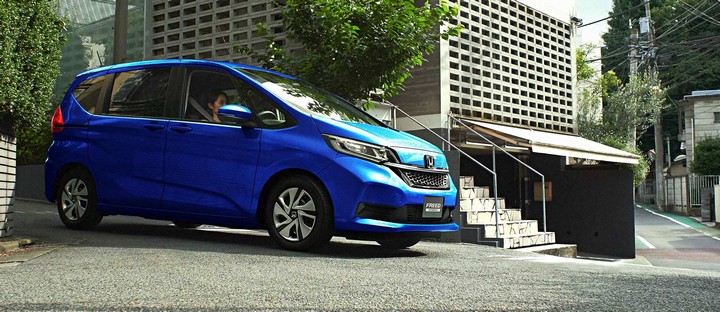
Above is the Honda Freed, up 10%. Below is the Suzuki Solio. up 9%.


13 January 2025

Japanese Brand Imports : 2024

I have always wondered why Asian countries like Japan set up factories overseas but don't import many or any of them. Japan has been doing it to varying degrees so what was 2024 like in this regard. I don't have a model breakdown but can supply brands. 

Nearly 76,000 Japanese brand cars entered the country, 60% of them Hondas which I assume are probably the Civic model. Nissan was next with just over 14,000 units, probably the Kicks. The others I'd have no idea. 

The 2024 number was the best since 1996, which was at the end of a three year period when imports of such cars was unusually high. In other words, 2024 was the fourth highest year for domestic brand importation. 


As for trucks, I think they are of the smaller variety which are popular in Asia. This year they took a 45% tumble. That was the lowest since 2017 from when after some better than average years followed.


Summary: So just over 90,000 vehicles in total were involved. As the passenger car imports are variable, it's anyone's guess as to 2025 numbers. I'd also like to know more about which models are involved.  

12 January 2025

Japan Passenger Car Sales : 2024


Scandals don't go down well in Japan. The culture is about face and losing it brings shame. Open apology and remorse mitigates some of the lost face but not all of it. That's how I see things but I'm not an expert in Japanese culture.

Daihatsu was recently exposed for fraudulent vehicle testing. Production was halted for months as a result as the sales data below clearly shows. Toyota is the owner of Daihatsu and they haven't been immune to the fallout with claims against falsified safety testing. Mazda obtains cars from them and may have been affected but less than the other two mentioned.

The Daihatsu Tanto Fun Cross (on the right) sums things up rather well. No fun for the company and no doubt has made the parent company Toyota very cross. It could be a while before Daihatsu is out of the woods over this scandal.

The data below shows Toyota sales were down 6% Daihatsu is much worse, of course, with a 41% reduction in market share. Mazda is down 15%.

This has enabled other Japanese brands unaffected by the scandal to improve their situation markedly. Things will gradually return to what they were before but damage is done for some time to reputation and hurts financially.  

In summary, total registrations were -7% for December and the full year. Import brands were -13% in December and -9% for the complete year so they did slightly worse. Toyota's loss has been to the benefit of other local brands, not imports (as expected), the latter are mainly premium marques so not competing against Toyota in any case.  

Data source: JAMA, JAIA.


22 December 2024

Kei High Rider Sales Japan : 2015-23


Kei cars take over a third of the car market in Japan. Their uniqueness means that this slice of the Japanese market is not accessed by foreign brands. There aren't that many models and some are shared between brands to keep them profitable. The government plays its part by providing incentives to assist with their popularity. 


This group of Kei cars are the tallest of them, around the 1.74 metres and slightly taller. Although all are just 3.395 metres long, this gives a surprising amount of room. 

The Honda N-Box (top pic) is the best selling of not only Kei but all cars in Japan. It was introduced at the end of 2011 and was the top selling model in 2012 so an instant hit. 

The Daihatsu Tanto is the second best selling Kei car and the third overall. It arrived at the end of 2003 so it seems to be the first of this very tall Kei style. 

Suzuki's Spacia (lower pic) is the third strongest selling Kei and sixth overall. When introduced in 2008, it was called the Palette but when the second generation came out in 2013, it was given the Spacia moniker. 

The Nissan Dayz Roox arrived in 2014 but simply as the Roox from 2020.  As there is a Nissan Dayz also, I assume the name change was to differentiate the models. It is made by Mitsubishi and it's a very solid selling car. 

Now we enter pancake territory with little to separate the cars. There are shared with larger selling brands and sell in limited numbers.

The Mitsubishi eK Space which is the donor model for the Roox sells in much smaller numbers. That's not surprising as Nissan is a much larger brand in Japan. The Mazda Flair Wagon is basically the Suzuki Spacia and sold since 2013. Finally the Subaru Chiffon, using the Daihatsu Tanto so as to have an offering in this segment. It was introduced in 2017. 

Summary: I find them quirky and yet fascinating too. I would be tempted to own one but they only come to New Zealand in very limited numbers as used imports. 

30 January 2024

Land Rover Japan / Korea Sales Comparison : 2009-2023


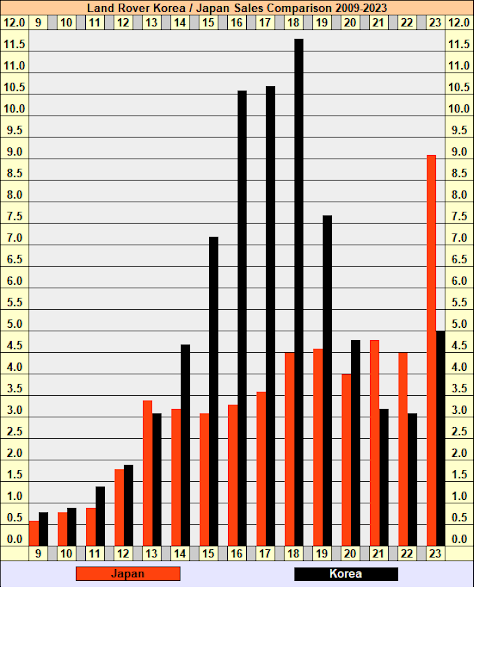
Two and a half years ago I did an article on this which included Jaguar. I'm updating this but for this one, it's just Land Rover. Have the past 30 months added much? Indeed it has so let's take a look at each country separately. 

Korea: There was progressive increases up until 2018. What happened then I don't know. I do know that in Korea importers can't be too successful or authorities get shall we say watchful. I don't have an inside story but sales tumbled without an obvious cause. 2023 saw a useful increase and 2024 will interesting.

Japan: Sales were neck and neck until 2014 when Korea bolted but Japan had modest gains. Japan's avoidance of a sales collapse stands in contrast to its regional neighbour. With supplies of the Defender in particular improved in 2023, a sudden jump not seen before occurred. 

Summary: What happened in Korea will never become common knowledge and it doesn't have to. It's their business and I'd rather hear nothing than be fed half truth or misleading spin. What we can say with absolute confidence is that 2023 was good for Land Rover in both countries. 


24 January 2024

Japan Top 70 Passenger Cars : 2023


The top selling models are Japanese and I've colour coded them to show regular green), Kei (yellow) and import (blue) car models. I do find Kei cars fascinating and wonder why they aren't exported more. I think the reason could be they wouldn't get government assistance like they do in Japan so not as attractive costwise. In addition, they are city cars or best suited to that environment rather than open, twisting roads.  


Honda holds the top ranking and has done so since it took over in 2017. It shows no sign of surrender either. Toyota and its subsidiary brand Daihatsu take the next four places. Even combining the Yaris and Yaris Cross (not done by me) isn't enough to topple the champion. The list is repetitive brand wise but that is how dominant local manufacturers are here. 

Two imports make the list, the full MINI range of which the one model would probably make it anyway, albeit a lower down the ranking. The Golf also makes it while the Mercedes-Benz C-Class just misses out. 

15 January 2024

Japan Passenger Car Sales : 2023


Registrations for December were up 6% and for the year +16%. Import foreign brands were up just 3% YTD and +2% in December. Import sales of non Japanese makes accounted for just 6.2% of sales. For an unprotected market, that is a very low figure. It's achieved through the encouragement of Kei cars, Toyota's reputation and loyalty to local brands.

Toyota took 34.5% of sales, its highest since the early 1990's. Understandably, most other brands lost share as a result. Lexus and Land Rover emphatically bucked the trend with impressive market share gains. The 'Diff' column shows market share change which makes their actual sales increase much higher.

For imports BMW and VW have been doing the 11-12 shuffle. As mentioned, Land Rover is getting stock and moving back up again. China's BYD has arrived and Hyundai is trying to make some progress in a market it struggles in. The Tesla figure is an educated estimate. 

Data source: JAMA, JAIA.

18 January 2023

Japan Top 50 Model Sales : 2022


The list below combines regular sales with Kei mini cars. The data is not released that way but combined here. No imports are shown as none usually qualify although the best selling list for them hasn't yet been released. The better selling are premium cars and less likely to hit the chart below. 

One cannot overstate how limited import model sales are. It's achieved by strong nationalistic loyalty, preferential treatment to the Kei car category that excludes anything imported and possibly a few other less obvious ways. 

The top model for 2022 is the Honda N-Box. Even the combined sales of the Yaris and Yaris Cross couldn't prevent it. Still, Toyota/Daihatsu models are the dominant force. The colours below are for regular and Kei car models and that shows how strong the Kei category is. 


15 January 2023

Japan Sales : 2022

A charging unit on the roadside is interesting


Registrations for December were +1% and for 2022 were -6%. Not too much difference in the end. The '+/- diff' column below is for market share change. 

Toyota, Daihatsu and Lexus all slipped slightly which is interesting as they are all the same company. All the other Japanese brands increased, presumably taking advantage of Toyota's loss. 

Mercedes remains the strongest selling import brand, even outdoing local premium Lexus. The Tesla figure is an educated estimate. Hyundai has been trying to get a toe hold in the market and it will be interesting to see if it can make something of this latest push.

Data source: JAIA, JAMA.

31 May 2022

Toyota Model Sales Japan : 2020-21


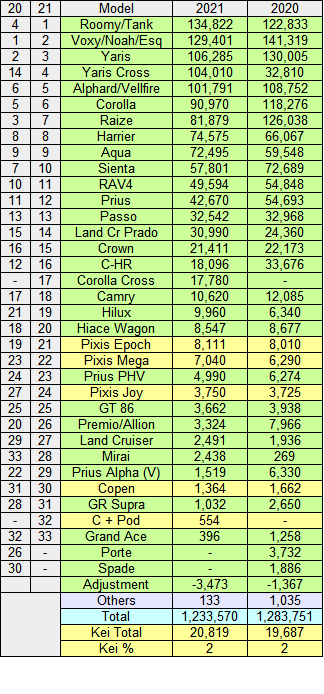
Toyota's place in the Japanese mind is reverential. It does nothing more than dabble in the Kei class despite it being a third ofall sales. It leaves that to Daihatsu and concentrates on the rest of the market which it takes close to half of. It runs dealerships in groupings, so some models shared across these with some minor variances. The Voxy - Noah - Esquire MPV is a classic case of that. 

The top selling combo is the Roomy-Tank mini MPV range (pic above), with 135,000 registrations. The Tank was discontinued in 2020 and all but a few registrations for 2021 were the Roomy. They are supplied by Daihatsu (sold as the Thor) and it also goes to Subaru under the Justy name. 

Next the are Voxy-Noah- Esquire range (pic left - 129,000) the Yaris (106,000) and Yaris Cross (104,000). The Alphard - Vellfire large MPV models nearly reached 102,000 sales. The strong sales continue down the list.
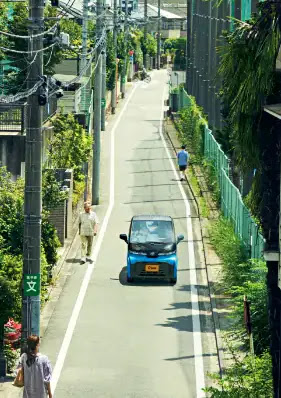
The few Kei models are highlighted in yellow and make up just 2% of all registrations. Most are sold as unrelated Pixis models. They are all supplied by Daihatsu apart from the C + Pod, a tiny electric car (picture above on narrow road). 

Because the model sales and total figure are not from the same source, I had to include an adjustment at the bottom of the list.