Showing posts with label Nation - Korea. Show all posts

13 September 2026

Korea Car/LCV Sales: 2026 (Jan-Aug)


Hyundai/Kia/Genesis has 72.3% of the market between them. That's what protectionism gives you. Boring for car buyers, but good for the economy. The importers that can overcome that hurdle are of the premium variety. 


Kia has passed Hyundai in an 'exciting' race at the top and is now pulling away. As Hyundai does better with LCVs, Kia's PC lead is even more pronounced. Hyundai is moving upmarket and that's probably the reason. 

Kia has by far the best selling vehicle in the form of the Sorento. It has three of the top four as it stands now. 


Tesla is doing well this year as is new arrival BYD, the latter only in its second year here. Smaller US brands Chevrolet, Jeep, Ford, Cadillac and Lincoln all declined. GMC was the exception. 

Some lower volume marques choose not to release sales figures, but this list gives a good overall coverage of the market. 

Data source: KAMA, KAIDA. Photos: Tesla Y & Hyundai Casper (Inster).

13 February 2026

Mexico Korea/China Car Production : 2025


Kia has had a plant here 2016 and JAC 2017 so both are relatively new. Kia is heavily export driven whereas for JAC its focus is more on the local market.

Kia: The plant has an annual 400,000 unit capacity so just under three quarters utilised at this time. Its purpose is to supply the American continent wtih about 75% of production exported. 

It also assembles Hyundai products, the current one being the Tucson. It isn't a major volume, making up less than 7% of production in 2025.

JAC: It assembles a range of vehicles, relying heavily on imported content from China. JAC recently increased capacity to 60,000 units per annum.  

It has a goal to develop more local suppliers. Some of the figures in the chart would only be viable with limited local content. 

The range is extensive, the models listed covering cars, SUVs, MPVs, vans and light trucks.  

Summary: Two very different assembly operations are shown here. One focused on fewer models at higher volume and the other the opposite. Yet they are both proving successful.  

Data source: INIGI. Photo source: Promexicoindustry.

19 January 2026

Korea Car/LCV Sales : 2025


1,657,000 passenger cars and light commercial vehicles were registered in 2025. The total market is up 4% with the modest import total up 17%. The 2025 total is 4% down on the average for the last ten years. 

307,400 imports or 19% of all registrations. The Hyundai Group secured 75% of the total! That's what protecting your market can achieve, not that it's needed. 

If it were just passenger cars that were being counted, then Kia would be the leader but Hyundai's stronger range of light commercials means the latter takes the lead here.

Hyundai is up slightly and Kia is down by similar proportions. Genesis is at its lowest market share since 2020 but is still a comfortable third. Renault has local manufacturing and it is up while the other two who do also, KG Mobility (Ssangyong) and Chevrolet, are less fortunate. 

Of the imports, BMW and Mercedes-Benz are as high as it is prudent to go. Tesla has leapt up the chart to be just behind MB and may be able to increase from here without concern. 

There is nothing of note in terms of sudden shifts in sales and rankings apart from BYD, which has arrived with as splash as per usual. Ferrari is now being reported, its 2024 sales figure is an estimate. Some other luxury marques aren't reported at all but the volumes they represent are minuscule. 

For 2024 articles, simply click on the links below:


Data source: KAMA, KAIDA. 


Korea Top 40 : 2025


It will have come of no surprise for most of you that local brands would be dominating the top of the list. All of the top 10 are domestic brand models and even a surging Tesla Y was unable to break into that elite group. 

The Renault Grand Koleos is made in Korea at its Busan plant, so only one of the top 18 is an import. The Chevrolet Trax is also a local, manufactured at the company's Changwon plant.

Photos: Kia Sorrento (above) & Hyundai Kasper (below).

14 January 2025

Korea Top 40 : 2024


There are no surprises as to which brands feature heavily at the top of the chart. It's the Hyundai and Kia show, shielded by protective import duty. Only foreign premium marques can realistically survive here and it seems even they need to be careful how they tread. 

The Kia Sorento went to the top and with the carnival made it a one-two for the company. The Hyundai grandeur fell from top to fifth. The Santa Fe (picture above) increased 50% and came in at third. 

Of the foreign models, BMW and Mercedes are the more popular and Tesla has a couple too. The Japanese aren't too prominent but did manage to get a Lexus onto the list. Renault and Chevrolet are overseas brands but their models featured here are locally made. 

13 January 2025

Korea Passenger Car/LCV Sales : 2024


Apart from some luxury marques, the data below covers the vast majority of sales. The total market was down 7% with imports suffering the worst of that. As a market that heavily favours locally made - both with steep import duty and occasionally other means - it is dominated by a few domestic brands. Kia got close to regaining the lead it held briefly in 2022 but couldn't quite do it.  

I can only assume the steep import duty is to protect the fragile and vulnerable Korean brands from being overwhelmed by superior foreign ones. Why else would they persist with it? They seem to get treated much more kindly when it comes to exporting as well. 

Hyundai's premium marque Genesis is doing well and BMW extended its lead over Mercedes-Benz. KG Mobility (formerly SsangYong) retained sixth spot despite a 20% loss of market share. Renault Korea was formerly known as Samsung and did well with new models arriving. Chevrolet relies on locally made models and its exporting. 

Imports lost two more marques for 2024 in the form of Jaguar and DS and Citroën a year previously. Nissan and Infiniti left in 2020. I did keep Renault sales apart from Samsung but now they are together under Renault Korea. The way some of the brands at the lower end of the list are faring, there may be more to follow. 

I used to get Tesla from the internet as best I could but it is now provided by Kaida. It has either jumped markedly or the previous source wasn't reliable. I'll text Elon later to confirm one way or the other.  

Kia has more top selling passenger car models and yet trails Hyundai on the list below. It's because light commercial vehicles are included and Hyundai is much stronger in that area. Just passenger cars and Kia is the more popular brand. 

Data source: Kaida, Kama.


24 December 2024

Korea Premium Sales : 2015-2023


While mainstream cars are all but nonexistent on Korea, the desirability of premium marques allows them to fare far better. I'm not sure this goes down too well.

Genesis is the leading premium marque and by some distance. It started in 2003 but became a stand alone brand in late 2015. However, it was in 2020 that it took the lead with gusto. 

In 2023 registrations added up to 126,600 units with the G80 being the best selling model (43,200).

BMW has been advancing steadily and pipped MB in 2023, with 77,400 sales. The 5-Series/i5 was by far the top model for the marque with 21,400 finding new owners.

Mercedes-Benz has been the second strongest marque for a few years now but a slight fall to 76,700 sales in 2023 put it back into third. Its big hitter is the E-Class with 23,600 sold. 

After that, the gap to the other players is not inconsiderable. Audi used to be much stronger but it was punished as a result of Dieselgate and sales all but stopped in 2017. Then a slow rebuild of sales. 

They have come back to some degree but have not fully recovered. In total 17,900 cars were delivered by the Audi importer with the A6 accounting from 7,600 of those. 

The chart below repeats the lower part of the main chart as it expands the lesser marque's sales so we can see things in more detail.
Volvo has been growing and nearly reached Audi with 17,000 cars registered. Volvo is well ahead of Audi in 2024 so another good year for the brand. 5,860 XC60 models were delivered. 

Tesla is a late arrival, gaining momentum quickly but then leveling off. 16,800 were sold with the Model Y doing the heavy lifting. 

Lexus delivered 13,600 cars, led by the ES model. It has a settled Toyota look to volume. Porsche sold 11,350 cars, the Cayenne being the leading model. The marque had a good over the past few years.

Land Rover is now alone with Jaguar pulled from the market in 2022. 5,000 Land Rovers were sold in 2023 with the Range Rover by far the biggest selling model.

Finally an unusual combination of Lincoln and Cadillac under the USA label. They are not big in numbers with 5,000 sales between them in 2018 the best result. So I combined them. 

I didn't include Infiniti as there are enough brands there already and the fact sales were low, not exceeding 3,200 (in 2016). It was also pulled from the market in 2020. 

Summary: Much more activity going on here than with mainstream cars. There are also many luxury marques plying their wares but their data is scarce. 

23 December 2024

Korea Local Mainstream Vs Imports : 2015-2023


Korea protects its car/lcv market so well that mainstream imports scarcely exist. Premium imports are not as price sensitive and do much better. 

The graph features Hyundai, Kia, other local manufacturers and import brands. The numbers on the left of the chart are in thousands so just add three zeros. 

Hyundai is the leader and hovers around the 600,000 mark. The best selling model in 2023 was the Grandeur at 113,000 units, nearly four times more than all import brands combined! 

Kia is next with a very consistent sales level. That's in the 530,000 region and its top selling model was the Sorrento at nearly 86,000. 

The 'Other Korea' category is comprised of KG Mobility (formerly Ssangyong), Renault Korea (formerly Samsung) and GM Korea (formally Daewoo). Two of those names sound suspiciously foreign so why are they not classed as such?

I'm glad you asked. Both basically sell only locally designed and made products. GM Korea does have a few import models but they sell in miniscule numbers. 

On to 'All Import Brands'. They currently cover Ford, GMC,  Honda, Jeep, Peugeot, Renault (separate to Renault Korea), Toyota and VW. Those that have dropped out from 2015 are Chrysler, Citroën, Fiat and Nissan. Collectively, they have dropped from 75,600 sales in 2015 to 30,600 in 2023. 

Summary. Choice in the mainstream area of the market is increasingly down to just two brands. If those two brands had one of their columns stacked on top of the other, the chart would have to be twice as high and the rest shrunk down to half of what you see now. 

So Korean brands enjoy unfettered access to many markets they all but shut out in return for mainstream cars. I assume the reason is to support the economy in South Korea. I guess the moot point is whether it's necessary anymore. 

Pictured are the KG Mobility Torres above and the GM Korea Trax below. In 2023 they reached 37,000 and 23,650 sales respectively.

30 January 2024

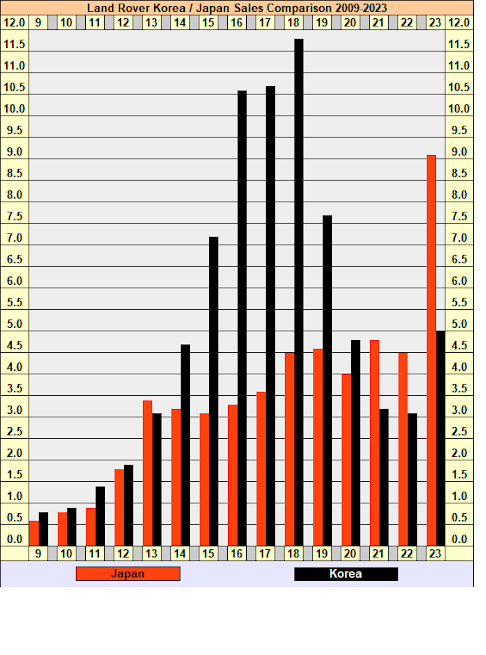
Land Rover Japan / Korea Sales Comparison : 2009-2023


Two and a half years ago I did an article on this which included Jaguar. I'm updating this but for this one, it's just Land Rover. Have the past 30 months added much? Indeed it has so let's take a look at each country separately. 

Korea: There was progressive increases up until 2018. What happened then I don't know. I do know that in Korea importers can't be too successful or authorities get shall we say watchful. I don't have an inside story but sales tumbled without an obvious cause. 2023 saw a useful increase and 2024 will interesting.

Japan: Sales were neck and neck until 2014 when Korea bolted but Japan had modest gains. Japan's avoidance of a sales collapse stands in contrast to its regional neighbour. With supplies of the Defender in particular improved in 2023, a sudden jump not seen before occurred. 

Summary: What happened in Korea will never become common knowledge and it doesn't have to. It's their business and I'd rather hear nothing than be fed half truth or misleading spin. What we can say with absolute confidence is that 2023 was good for Land Rover in both countries. 


18 January 2024

Korea Top 50 Passenger Car Models : 2023


Nothing is surprising about the list if you know anything about the Korean car market. The top 20 models are from domestic brands. The most telling part is where they are placed in the ranking list. If you add the Korean assembled Chevrolet Trax and Trailblazer plus Samsung (now being shown as Renault below), then it gets very one sided. 

How many markets do you see only one Japanese brand name in a top 50 list? It's so heavily protected that unusual things like that happen. Import models are of the premium variety but mainstream brands are conspicuous by their absence. The reason import duty is still needed? 

12 January 2024

Korea Car/LCV Sales : 2023


Registrations were up 4% with imports down 4%. The 'Diff' column shows market share change, with Hyundai in particular doing well. Both it and Kia have over a third of the market and if one adds Genesis into the mix, three in every four cars sold in Korea is by the Hyundai Group. Staggering! 

SsangYong or KG Mobility as it is now known in Korea was down and Renault Korea (née Samsung) is sliding downward as it reinvents itself. Chevrolet too makes cars here and it had a tiny sales increase but lost a tiny share of the market. 

As for the rest, their share is 16.5%, higher than Japan but not still very low. Citroën left last year but Polestar arrived. Jaguar sold one car in November and none in December and it appears that the marque has been dropped in Korea. GMC arrived in February 2023 with the Sierra pickup truck. Mind you I don't know if there will be much yee hawing around Seoul. 

There are a few minor premium and luxury brands not reported here but most are. Still, that really isn't a long list of brands but there is no real incentive for a mainstream brand to do battle for a few car sales. Heavy import duty keeps them away. Are local brands like Hyundai and Kia so feeble that they couldn't survive without strong protection? It seems so. 

Lexus and Land Rover are doing well so far after each had a poor 2022 but VW and Honda are not looking too flash in 2023. Neither BMW nor Mercedes have had a great year but the same cannot be said of Porsche. As usual mostly tough times for vehicle importers in Korea. 

Data source: KAMA, KAIDA.


28 January 2023

Is Korea Being Treated As Hogu?


I was reading a Korean article online (translated) and it said some car companies view Korea as a hogu. What does Hogu mean? It's the amour worn by practitioners of Taekwondo. But is that all?

A Google search revealed it also can also be a slang term meaning someone who is foolish (or stupid) and easily deceived by others.

Reading on, it said Tesla has an overall operating profit of 12.1% but in Korea it's 1.5%. Porsche 16% and 3.5%, Mercedes-Benz 17.2% and 3.5%, BMW 12% and 2.1%. It was claimed that cars are overpriced when sent to Korea to reduce profit made within Korea. this is a trick to avoid corporate tax in Korea. These are successful marques in Korea, MB sold over 80,000 cars in Korea last year, BMW 78,500, Porsche 9,000 and Tesla estimates vary wildly.

If true, why are companies picking on Korea to do that? High corporate taxation in Korea would be an obvious reason but I don't know about such things. Is Korea a hogu, a place that easily tricked? I know that the second point isn't true. For example, it watches import brands' claims on fuel consumption closely and severely punishes any perceived transgressions in that regard.  

As for the Korean car market, it's no eldorado. Some of the casualties of late have been Subaru (left in 2012), Mitsubishi (2013), Fiat (2017), Nissan and Infiniti (2019) and Citroën sold its last car in April of  2022 and Jaguar sales all but ceased. 


So if Korea was foolish enough to be taken advantage of, some brands missed an opportunity. Is this a way to discredit successful import brands or unfair tax avoidance? I can't say but the culture in Asia generally is anti trade and pro export. The Korean car market - like many others in the region - is protected when it is now strong enough not to need any at all. 

I'm not into politics be it government or business so I'm not playing such. Fairness is very important to me as it is for most people yet the world is anything but fair at times. I just want to know what is the truth in all of this but maybe it's not for us to know.  

22 January 2023

Korea Top 50 Model Sales : 2022

There is no surprise that Korean models totally dominate this list. Premium imports are less affected by import duty so they make a mark further down. The Genesis brand was created to counter them and with a price advantage is doing that to some degree. What Genesis doesn't have is pedigree.

Chevrolet makes cars here but few find homes in Korea. Those that make this list are a sizable distance from anywhere near the top. At least SsangYong and Samsung each slipped a few models in. If I was to describe the Korean market, it would be the Hyundai/Genesis and Kia show. In other words, a rather boring place to go shopping for a new car unless it's a premium one. 

Below yellow is for Korean brands, Europe aqua, purple for the USA. As already mentioned, imports are limited due to import tariffs and other factors. Japanese brands are conspicuous by their absence.  

Data for the Tesla models are an educated estimate. The brand is making an impact although not as much as they would like I'm sure. It will be interesting to see whether the Models 3 and Y can move up next year. 

Korea Car/LCV Sales : 2022


Registrations for 2022 -2.5% on the corresponding period of 2021. The '+/- diff' column below is for market share change. 

The data is for cars and light commercials. Kia overtook the usual leader Hyundai but there is nothing in it. Genesis is comfortably ensconced in third place where it will stay indefinitely. BMW and Mercedes have pushed Ssangyong and Samsung out of third and fourth. In reality, they haven't though as Hyundai and Kia did that, being their true competitors.

Green shading shows market share gain and looking at the chart, we see that the biggest brands and some premium ones are increasing in that regard while smaller ones are declining. The reason is clear, excessive protectionism with mainstream imports, in particular, having all but disappeared. 

Mainstream imports have little chance of survival here with import duty killing them, only premium import marques can cope with that. Subaru left in 2012, Mitsubishi a year later, Fiat in 2017, Nissan and Infiniti in 2020. Citroën has now stopped selling here and DS registrations are down to a dribble. I wonder if Jaguar might as well go, being outsold by Rolls Royce and blown into the weeds by Bentley.

Tesla had a relatively poor year in Korea and what I read in the Korean media, they are making the most of it. The focus is on price cuts to show how Tesla has struggled with sales globally in 2022 but that's about tarnishing a reputation unfairly. Sales for the year globally were strong and I see it as maintaining momentum going into a challenging year. 

Polestar has arrived and did well in a short space of time. Both Bentley and Lamborghini had a good year so they need to watch their backs. A few smaller exotic brands don't report sales but otherwise, that is a complete list. That said, it's not a long list for reasons already mentioned. 

Data source: Kama, Kaida. 

16 January 2023

GM Korea Plant Sales : 2021-22


I did an article about this last year with some extra data you may want to apprise yourself of. Simply click here to read it. As for the current situation. GM persists with its operations in Korea, despite little local interest in the cars that make. Exports are required to make it pay and that's the plan.

With domestic sales, cars are down 40%, RVs =15% and light commercials -61%. Collectively, the domestic total is -31%. Not exactly successful.

Moving on to production, the Spark, Traz and Malibu have all been phased out in 2022, with the Trailblazer continuing and a new small crossover to be added in 2023. The production goal is 500,000 units, quite a target if achieved. It is intended that several electric models are to follow. 

22 February 2022

GM Korea Plant Sales : 2020-21

I thought GM would be making tracks
but instead, they are still making Trax

According to GM's Chevrolet pressroom, the Korean operation is substantial. I assume it's essentially up to date but some of the detail is not current. So here is what it states when it comes to facilities. 

At the Bupyeong HQ, the Trax, Trailblazer and Malibu are assembled. There is also an engine shop. The Changwon plant makes the Spark, Damas, Labo and engines. At Boryeong are made transmissions, testing is done at the Cheongna Proving Ground. There is also a technical centre, stated as GM's second largest. 

So what does all of this produce? Below we see 225,000 cars 3,500 light commercial vehicles. That's 36% down on 2020. The passenger car figures are a mixture of domestic sales and export plant sales. The LCVs are local sales only and I believe are being discontinued.

GM has recently been decisively active in pruning its global operations. Looking at the Korean wing I wondered why the hatchet hadn't fallen here as well. Rather, it is seen as an opportunity to increase production, mainly for export. 

Recently GM showed what it wants to do. A new compact crossover is to be made here and in future electric vehicles. It needs to use what is here to greater effect and this is the strategy going forward. 

25 January 2022

Korea Top 50 Sales By Model : 2021


I colour coded the list to show where brands historically originated. It paints a clear picture of total local dominance. When buying a mainstream car, in most places when looking for a new car the punter is spoiled for choice. Not so in Korea. 

Korea Sales : 2021


Like other Asian countries, when it comes to registrations Korea keeps import brands separate from domestic ones. Sales for all the market in December were -6% and for the year -8%. Imports were -24% and +1% for the corresponding periods. The +/- column below compares market share in 2021 to 2020. 

Domestic: Kia and Hyundai have the mainstream market pretty much to themselves. Samsung, Ssangyong and Chevrolet all compete in that arena but can't do anything to blunt their dominance. In fact, in 2021 they lost ground to them.

Now Hyundai has brought out the Genesis brand to take on imports in the premium segment. The latter previously had that area to themselves but not anymore. Higher priced cars can absorb duty yet still sell well but the locals have taken to Genesis in a positive way. 

Imports: The number of brands available was reduced by two in 2021 with the loss of Nissan and Infiniti. JLR has gone from 1.0% market share to 0.2% in just four years. Strange. Others have done really well over the same timeframe. It seems brands fall in and out of favour and maybe not just with the buying public. No one talks about it though, so it's hard to be certain.

Data source: KAMA, KAIDA.

Updated: 22/02/2022 to include Tesla.

21 August 2021

JLR Japan / Korea Comparison : 2009-2021


Trying to get the reason for what happens in a given situation is not easy. It can come down to getting the facts as best we can and then interpreting them. However, we may not have enough information for an informed opinion and the Korean car market is like that for me. The sudden shifts that occur don't give the appearance of market forces alone. Is it corporate decisions or external pressures?

A few years back, premium imports boomed in Korea and the likes of JLR were beneficiaries of that along with other marques. Then around 2018, something happened. No explanation I've read about but other import premium marques continue to grow so why is JLR falling away in such a striking manner?

Below is a comparison with Japan, a nearby nation. Its sales have climbed consistently since 2009, with 2021 looking like being a record for the period under consideration. I've added an estimate for 2021 in a slightly different colour. Sales have gone from barely over 500 in a depressed 2009 to perhaps 5,000 by the end of the year, assuming disruptions don't impact too much in that time.

Korea started out much the same but by 2018, registrations passed had 11,500. Then something happened and the number will do well to exceed 2,500 in 2021. If direct competitors were experiencing the same fall then it would be a broader issue. The reduction is too steep to be just a loss of public interest or confidence. If the reason(s) have been explained, I didn't get the memo.


Turning to Jaguar was one way I hoped to clarify things but all that did as far as I was concerned was muddy the waters. The movements are much more consistent and in harmony with the Jaguar brand repositioning itself as a boutique brand rather than chase volume. One point of note is that while Jaguar finding its level in Japan, it's still in freefall in Korea.  Some mysteries just aren't going to be solved. 

Sunny times ahead I wager for Jaguar