Showing posts with label Nation - UK. Show all posts

18 July 2026

UK China PC Brands: 2025-26 (H1)

Registrations of Chinese brands in the UK was 9.8% in 2025 and are currently at 15.3%. That's steady progress and will only become more so. 

European brands that have dominated the market will be watching with intense interest as the UK hasn't been resisting this influx like the EU has been.

The data below has been extracted from the complete list of brands. MG got in early in the UK and benefits from that, but they seem to be hitting a ceiling. Newer entrants are making large gains. Smart is a Chinese joint venture brand, so I view it as suitable for inclusion.

UK Passenger Car Sales : 2026 (Jan-Jun)


Registrations were up 11% in June and 9% YTD. The current top six all lost market share on 2025. Mercedes managed to climb three places despite a 1% fall due to Toyota, Nissan and Hyundai all dropping more. This Nissan's lowest ranking since 1971 when they were named Datsun. Hopefully, the second half of the year will be more successful.   

Chinese brands are making their presence felt but for now only MG has managed to enter the top ten. How far they will go is a moot point. With EVs taking 30% of registrations in June and 25% YTD, one would think Chinese brands will relish the opportunity to capitalise on that. 

Data source: SMMT. Photos: Nissan Sunderland & Omoda. 

05 May 2026

UK Bus & Coach Registrations: 2025-26 (Q1)


It's a tough year so far for those selling buses in the UK. Registrations were down 37.7% in Q1. Apparently. the SMMT say it's due to two years of high growth and statistically that looks to be correct. 

I thought it might be larger buses suffering the most but no. Single deckers were down 15.5%, double deckers -22.1% and mini buses down a whopping 56%. Since 2021, mini buses have gone from two thirds to one third of the bus market. 

A mini bus is up to 6 tonnes and has from 9 to 17 seats. Clearly they have fallen out of favour. Single decker buses are outselling them and double deckers aren't far off from doing the same. The suddenness is surprising. 

So some of the larger falls are due to that change. It's nice to see Northern Ireland based Wrightbus doing well under trying circumstances, including indifference toward supporting locally made. Alexander Dennis manufacturers locally with its electric buses using BYD batteries. 

BYD is also doing well with electric double decker buses made in China. Yutong uses a local company for final assembly of its buses, the main structure made in China. 

Data source: SMMT. Photos Wrightbus & Alexander Dennis. 

09 April 2026

UK PC/LCV Sales : 2026 (Jan-Mar)


The chart shows market share for a full 2025. The Share +/- column shows movement in market share, not sales volume. 

This is a first for me, combining passenger car and light commercial registrations for the UK. It puts Ford on top thanks to its strong LCV presence. 

Volkswagen has closed the gap, but only by virtue of falling less. 

Kia has entered the UK's LCV market in 2026 and is doing very well with that. Vauxhall has done well all round and moved up four places but BMW has been unable to emulate Mercedes-Benz' success. 

Despite production issues, Land Rover has done well to increase its market share by 19%. It's LCV division is up 37% YOY and exceeded 2,600 registrations. 

Chinese brands are making their presence felt at the expense of legacy brands. The Jaecoo 7 was the best selling model in March. 

Data source: SMMT. 

Photo sources : Ford (Transit Custom), JLR (Discovery & Defender LCVs)


10 February 2026

Brands From China In The UK : 2025


The UK has seen a sudden rush of new Chinese brands entering the market. MG has been around since the demise of MG Rover but only reached five digit volume in 2019. 

The list to the right has UK ranking compared with all brands, market share and increase or decrease of sales. 

The list only covers brands that exclusively source cars from China.  


MG has an advantage of being well established before the recent invasion but with market share up only slightly they may be feeling the impact of the new arrivals. BYD is its usual aggressive self and the rest have arrived in 2024 or 2025, the latter shows a 'n/a'. 

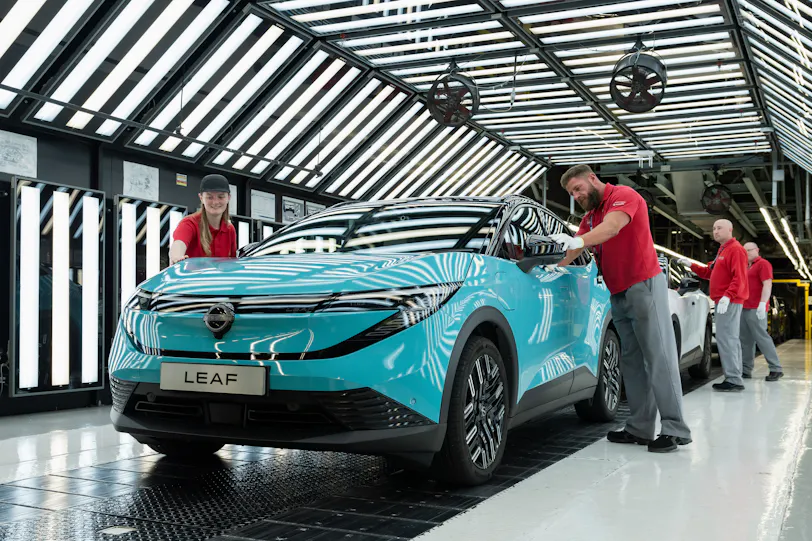
I have yet to investigate other European markets but the UK would seem to have far more Chinese brands doing well. The EU has imposed tariffs on electric cars due to their claim of unfair subsidies. The UK isn't doing the same. I wonder how Nissan Leaf sales will go in the UK, as it is produced there and doesn't need unfair competition. 

Photo source: MG (HS), BYD (Dolphin Surf) & Nissan (Leaf).

12 January 2026

UK Passenger Car Sales : 2025


Registrations were up 3% in 2025. That's still at a level below the best years, but if nothing else, it's very stable. However, 2025 was 5.1% below the average of the previous ten years.

VW is now well established at the top, a position it took in 2021 from Ford. BMW retains its second placing, just ahead of Ford, which has made a comeback, moving up two places compared to 2024. 

Jaguar is no longer sold here and stock ran out here a long time before many other countries. A quick run out is about the only thing Jaguar head honchos have done well of late. 

MG retains 10th place, doing well to hold that considering several up and coming Chinese brands which potentially could canabalise some sales as they often compete directly. One thing is for certain, all these new brands are making for a long lists.

Best selling models:

Ford Puma - 55,488
Kia Sportage - 47,788
Nissan Qashqai - 41,141 (photo above)
Vauxhall Corsa - 35,947
Nissan Juke - 34,773 (photo below)
VW Golf - 32,478
MG HS - 30,191
Volvo XC40 - 30.404
VW Tiguan - 29,857
Hyundai Tucson - 28,613

Best selling BEV Models:

Tesla Model Y - 24,298
Tesla Model 3 - 21,188
Audi Q4 e-Tron - 14,433
Audi Q6 e-Tron - 13,148
Ford Explorer - 12,237

For the 2024 article, simply click on the link below:


Data source: SMMT (mainly). Picture Source: Nissan.


18 September 2025

Land Rover UK Historical Market Share


I have no history with the marque whatsoever. I may have driven in one many years ago but that's it. Yet I'm keen on them and like their design styling. 

Land Rover got into volume as new models were added. By the time 2001 arrived, there were four in total. Three were for to the passenger car segment and one was mainly a light commercial. The figures below are compared against all vehicles sold in the UK. 

In 2001, LR were taking 1.6% of the total. The fact that the data includes cars, trucks and buses, none of which LR compete with, it was not a bad result. The Evoque was released in 2011 and that noticeably lifted the volume as it quickly became the best selling model.

Another lift came with the Velar's release in 2017 and the same thing for the new Defender in 2020. There was a slight dip after that but a recovery came almost immediately. Current share is nearly double over the period below, thanks to  a wider range of models and the premium 4x4 SUV market is quite a popular one. 

A Defender Sport model is apparently on the way. It's reported to be a smaller and more affordable than the current Defender. That would be a model that would surely fit nicely into the range as other LR models head more up market.

Commercial sales are not that large for LR. They were 13% of the total sales in 2001 and were just under 9% in 2024. Two years ago, it was under 6% so a growth in that area of late. 


31 August 2025

Vauxhall UK Historical Market Share


While the Vauxhall name disappeared from NZ many years ago, I've had some contact with the Vauxhall brand. My parents had a Victor and then a Velox, both well made cars from what I can remember. In my first job, the company vans were CF Bedfords (Vauxhall's van division name) and they were a good van. 

When I visited the UK on my first overseas trip, I hired an oldish Vauxhall Chevette from a small garage and toured Old Blighty in it. It was a nice little car to drive. My last encounter with the brand was when I married my beloved, she came with the last model Viva and I have to say the least impressive of all the Vauxhall products I'd been involved with. Enough of the reminiscing. 

Going back to the 1960's (where my data starts), Vauxhall was some way behind BMC and Ford. It was close to the Rootes Group in size (it became Chrysler UK). It was a steady third in the UK through the 1980's and the consistently the second biggest brand in the 1990's. 

The graph below shows GM Vauxhall's vehicle market share from 2001 through to 2024. It includes light commercial vehicles. It was doing well initially, with the Corsa and Astra models leading the way and selling at almost identical levels. The Vectra had been a big selling model but now not so much. 

Then a decline kicked in from 2014. The Insignia was never that popular and the Astra was losing ground. The Corsa held up better but also suffered. GM was losing money on its once profitable European operation and in 2017 sold it to PSA.

People were switching to SUVs and crossovers and PSA lost no time in introducing two. The figures indicate they didn't sell that well and the decline in market share continued. By 2024, the Corsa (picture above) was the best selling, followed by the Mokka. 

Light commercials have become a much greater part of the overall sales, going from 7.5% of the brand's total in 2021 to just over 27% now. I presume that helps the bottom line but market share now being below 5% shows how far Vauxhall has fallen in terms of volume. It mirrors the fall that sister brand Opel is experiencing across Europe. 

Is this a problem? What it comes down to is profitability, and Stellantis has been able to leverage cost savings in Europe through shared platforms and the like. Vauxhall will likely remain a viable brand in the UK, but not chasing volume just for the sake of it. 

22 February 2025

UK Truck Registrations : 2024


Truck registrations in the UK have been going well and 2024 was also a good year, despite a 3% dip in the total. There aren't many brands involved - ten in all - with most being European. 

The leader is DAF Trucks (picture above) which is how the SMMT names it but I've gone with its UK name, Leyland DAF. The vehicles are sourced from the UK plant in Leyland, Lancashire, and from Europe. It's the third consecutive year market share has fallen, albeit only slightly on each occasion. It has maintained five digit sales volume every year since 2014.

Then comes some heavy hitters from Europe before the first of two Japanese brands in the form of Isuzu and Fuso, the latter owned by Mercedes-Benz. In between them is Dennis Eagle (pic below), a UK based maker of waste management trucks. The 956 registrations was the best result since 2013 and the second best this century. 

Data source: SMMT.


UK Bus Registrations : 2024


By the term bus, it surely includes vans with seats with the vans over a certain size. Hence, we see Ford and Peugeot leading the way in 2024. I'm interested in the full sized bus but that is how the data is supplied. 

Registrations were up an impressive 70% but still only the best year since 2016. The 'Diff' figure below is for market share change so any brand in yellow would have increased volume but not kept up with the surging market. Overall, the best result since 2017 when nearly 8,800 were registered. I'm not sure why there was a dramatic fall after that. At least it's returning to better numbers.  

Of the local companies, Alexander Dennis (picture above) managed an increase in share and the highest sales figure since 2019. Northern Ireland based Wrightbus (picture below)- which are leaders in hydrogen buses - reached 850 units registered, 2017 the last time that figure was bettered. BYD are not a UK brand but the bodies on their buses may be provided by Alexander Dennis.

For imports, diesel buses have a 16% duty and electric 10%. The latter seems too low to protect local manufacturing and imports from China could prove disrupters for local manufacturers. That probably needs a review to provide some help to protect domestic electric bus manufacturing - which use Chinese made chassis' anyway - but unlikely to happen. The 2025 figures may have some different brand names included, assuming they will be reported. 

Data source: SMMT.

07 January 2025

UK Passenger Car Sales : 2024


Registrations were 0% in December and up 3% for the complete year. VW took the lead in 2021 when Ford abdicated its place as the UK's leading marque. It's turning to more profitable light commercials is the reason but if other manufacturers can justify making less profitable vehicles, I wonder why they can't. Regardless, they won't be coming back to the top again. 

I wonder if BMW has its eye on the top spot as it brushed aside Audi and made useful progress. A way to go yet of course. Toyota's dropping two places surprised as in most other places it's doing much better. Vauxhall is also heading the wrong way as it ceded six places in doing so. 

Nissan is doing well but as a major manufacturer in the UK should be supported more. Both Land Rover and Jaguar have had a more than useful year but the latter will be unable to sustain this as it has ceased supplying cars and now just clearing existing stock. I think it's all too extreme but dealers do at least have Land Rovers to sell.  

As an interesting piece of trivia, Volvo sold nearly 47,000 cars in Sweden and Land Rover just over 450. In the UK, Volvo outsold Land Rover by over 5,000 cars.

Data source: SMMT.

16 March 2024

UK Brand Passenger Car Production : 2023


Pessimism could have been the expected emotion as Honda (2021) and Opel/Vauxhall (2022) ceased passenger car manufacturing in the UK. However, an improved supply of semiconductors has more than compensated as the figures show. They are rounded with a few estimates. 

Nissan: Production was up 36% and accounted for 36% of the total as well. The Qashqai made up 200,000 units, the Juke 100,000 and the Leaf 25,000. 

Land Rover: The Range Rover and Range Rover Sport were the main contributors with about 130,000 made in total. The Evoque and Velar combined 60,000 and the balance was the Discovery Sport. All up, 23% of the total.

MINI: The hatch/cabrio and Clubman are made at Oxford with the former the main contributor but I don't have a mix breakdown. 1 in 5 of the total manufactured. 

Toyota: It makes just one model, the Corolla. The Suzuki Swace is basically the same car and I estimated how many were made. They were then taken away from the Toyota figure. A 'could do better' 13% of all cars made in the UK.

Jaguar: About 75% of production is the F-Pace. The balance is F-Type, XF and XE in that order. Jaguar hasn't been handled well by JLR but its eventual move to luxury car territory is where the marque is being taken. 


The rest: Bentley dropped a bit, Mclaren up a bit and Lotus went into warp mode with the Emira. Otherwise, it was steady as she goes.

23 January 2024

Germany / UK Brand Comparison : 2023

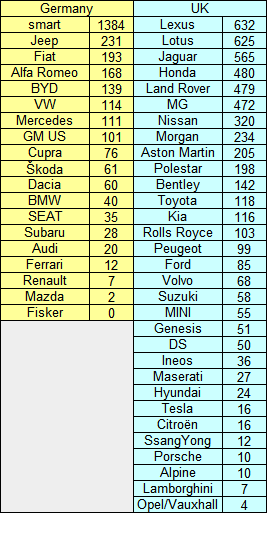
Lexus has over 600% more market share in the UK

The two largest car markets in Europe are compared in a brand head to head. Market share is compared and a percentage figure favouring one country appears in that country's side of the charts. Some predictable outcomes and the odd surprise.

Overview: The UK has more brands on its side because the number one in both countries (VW) leans heavily in favour of Germany in terms of percentage, which soaks up a lot of market share.


German brands:
VW and Mercedes-Benz are both over 100% larger in Germany. VW is number one in both locations but massively more so in Germany. BMW has 40% more market share in Germany and Audi 20%. 

German owned Škoda, smart, SEAT and Cupra all do better in that country. Surprisingly, Porsche has 10% more market share in the UK than its home market. 

UK Brands: They do much better at home, especially as the German market is very parochial which accentuates that. For example, Jaguar has 565% more market share in the UK without being as popular as it should be there. 

French Brands: Renault and its budget brand Dacia do better in Germany but the rest favour the UK. Peugeot has double the market share in the UK. 


Japanese brands: Subaru and Mazda make the Germany side but all the others are in the UK. Honda has nearly 500% more market share in the UK! Mitsubishi isn't sold in the UK so not included.

The rest: Korea is stronger in the UK. The USA is divided with Jeep and GM on opposite sides to Ford and Tesla. Fiat and Ferrari are on the German side but Lamborghini and Maserati the other.  

Volvo has 68% more market share in the UK and Polestar 198%. BYD is stronger in Germany and Fisker was about even. 

Summary: Few surprises here with Germany very supportive of its car industry at the expense of most others. The UK has just about thrown its industry away with incompetence at all levels but still has some premium marques that are given some support at home.  

Opel is just about as popular as Vauxhall 

15 January 2024

UK Passenger Car Sales : 2023


Registrations reached 1.9 million for the year. Registrations were up 18% for the year and in December +10%. That was the best result in four years but is still some way back from the highest of years before that. 

Volkswagen made it three in a row at the top despite Ford trying to keep them honest. Audi will probably pass Ford next year to make it a one-two for the VW Group. BMW, Toyota came next and they and all lost market share. 

Nissan is having a better year after a couple where I wondered what was going on. The new Qashqai seemed to take ages to surface and production at Sunderland retreated. Semiconductor shortages wouldn't have helped either. Nissan is starting again to look like the one Carlos Ghosn presided over. 

The 'Diff' column shows market share change.


Land Rover was another that lost its way for a couple of years and like Nissan, is starting to hit its straps. Vauxhall was the second best selling brand in the UK from 1989 to 2016 inclusive, 28 years by my reckoning. It's now seventh and at a level it can resonably sustain. There is no point chasing volume unprofitably. 

Lotus is running hot with the Emira and the British owned (but not much else) Ineos Grenadier has arrived. The BYD and Ora Chinese brands touched down in 2023, accompanied by Fisker and Chevrolet. 

Data source: SMMT.

On to the top ten models. Ford still reigns there with 49,591 Romanian built Pumas being registered. The locally designed and made Nissan Qashqai was up next (43,321) ahead of the Vauxhall Corsa (40,816). The Kia Sportage (36,135), Tesla Y (35,899), Hyundai Tucson (34,469) and the MINI (33,385) came in next. 

The top ten is rounded out with another British model, the Nissan Juke (31,745), Audi A3 (30,159) and Vauxhall's second in this exclusive list (29,984). The picture below shows the Qashqai as #1 in 2022 but while not 2023, maybe 2024.

31 March 2023

UK Plus / Minus Percentage : Import / Export

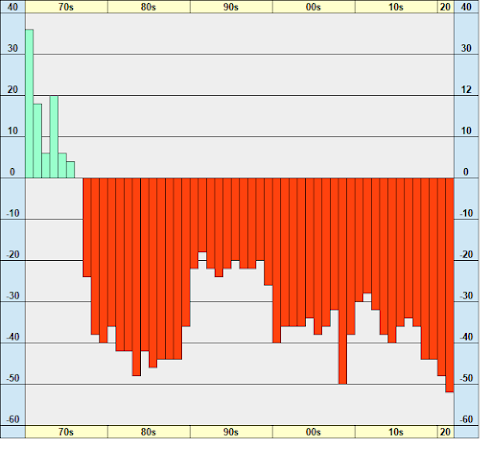
At the beginning of the 1970's, the UK was exporting 36% more passenger cars than it was importing. To put that into time context, the UK joined the EU in 1973. By 1977 it was neutral and thereafter it has been in the minus region.


In 1970, BLMC was in a net positive of 354,000, Chrysler (Hillman) 147,000, Ford 126,000, Vauxhall 61,000 and Jaguar 16,000. Land Rover's passenger car sales were negligible at this time. Taking off imports the net positive was 456,000.

By 1978, BL was almost alone, with 212,000 more export cars, Chrysler 83,000, JLR 23,000. Vauxhall was now minus 47,000 and Ford -68,000. In total the UK was now a net importer to the tune of 369,000 cars. That's a turn around from 1971 of minus 825,000 cars! Just eight years. Staggering.

Ford and GM were moving production to the EU and BL was in trouble so a double whammy. Just when it looked all over, the cavalry arrived in the form of Japanese car makers. Nissan in 1988, Honda 1992 and Toyota 1993. It wasn't enough to return to positive territory but it stopped the rot. 

Then Peugeot (who had taken over from Chrysler) pulled out of the UK around the same time BMW left MG Rover in a mess which folded shortly after. Toyota allowed its operation in the UK to shrink, Carlos Ghosn's departure from his post coincided with Nissan's UK diminished role within the R-N alliance and Honda left European manufacturing.

In 2022 the UK imported more than double the cars than it exported. Then a couple of the remaining players are seeking more government inducements to keep on investing in UK car manufacturing. One rather cynically as it recently posted huge global profits. I guess when some sense vulnerability...

The UK public has long since stopped caring for its car industry. Some say foreign ownership means zero benefit for the economy. Either a feeble attempt to justify their lack of support or maybe they need to give their heads a wobble. 

I'm picking it may retreat back under the 50% mark in 2023 but not by much if it does. Will the locals care if the UK car manufacturing lives or dies? I'll let Joni Mitchell have the last say: "Don't it always seem to go. That you don't know what you've got 'til it's gone?"

08 January 2023

UK Sales : 2022


Registrations for December were up 18% and for the year -2% so nearly a positive result. Still, it was the lowest total since 1982 so let's not get excited here! The '+/- diff' column below is for market share change.  

Kia was top after three months but then Ford took the lead only to have VW move into first place with a strong December surge. Even so, Tesla was the best selling brand in the last month of the year with nearly 16,400 registrations compared to VW's 13,100 and Ford's mere 7,650 odd.  

Ford was for decades of being the leading brand, often outselling other brands decisively but that sort of dominance is over. VW only just exceeded 8% share, that being a very low percentage for the best selling brand. I can't think of another market where such a low percentage took the top spot. 

Toyota and Kia are well placed to move up the rankings if Audi and BMW falter in any way. Tesla still didn't make the top ten despite it's December heroics. MG actually outperformed it terms of percentage increase. 

Land Rover's 17% loss of market share and Jaguar's 34% drop is concerning as this is their home market. No Mitsubishi? That's right, sales have stopped for them. Some of the smallest selling brands are estimates but they won't be far off the mark.

Data source: SMMT.

16 February 2022

UK Net Production : 1971-2021

We had one as a family car. It was good


When I was a lad, our cars were all of UK origin and they served our family well. Gradually things changed and eventually Japanese brands replaced them. The British car industry wasn't the same as it once was and manufacturers from Japan took full advantage of that. The UK car industry has made a comeback but it was never really supported by the UK public.

We had one of these too, except it was a Leyland model. A good car


At this time I recall more than once raising online the poor record of support for the UK car industry within the UK. In each case, I was told that it made no difference to the local economy where the car was made. I asked how could design studios and large assembly facilities employing large numbers make no difference? They all pay tax and spend the rest within the country. 

As they tried to justify their actions, they would inevitably reply the manufacturers are all foreign owned so it puts nothing into the economy. I replied that buying imported cars offers nothing compared to the benefits of buying locally made. They insisted it made no difference. 

The people concerned weren't stupid, they were exhibiting intellectual dishonesty. Their illogical reasoning justified their selfish actions. Of course, people should buy as they feel fit and I'm all for free trade. However, to ignore local workers en masse as now happens in the UK undermines local manufacturing.

I hired one of these in the UK. Nice car to drive


To show how the UK public has changed within a generation, the figures below paint a clear and sobering picture. If you are from the UK and don't want to face reality, I suggest you leave at this juncture. If you are prepared to see the facts, read on. 

1971: There were not that many manufacturers but they all produced well, supported in the local market and exporting strongly. The country was a net exporter to the tune of 456,000 units or 35.5% over imports.

1981: What a difference a decade makes! Domestic sales were up but BL was in decline, Peugeot had taken over from Chrysler and the transition wasn't pretty, while Ford and GM Vauxhall were importing more rather than they were building more in the UK. Now a net importer by 530,000 (-36%). 

1991: BL was now MGR and along with Ford had stabilised. Nissan arrived, Vauxhall had bounced back although Peugeot had slumped in volume. Net importing was down to -355,000 (-22%).

2001: More manufacturers but not a good end result. Nissan, Land Rover and Jaguar were fine and Toyota and Honda were now on board. Even Peugeot had got numbers up. On the flip side, BMW was already messing up MGR, Vauxhall was relying more on imports and Ford was all but gone. 

Production was actually up over the decade but sales were booming in the UK and local production hadn't kept up. Net importing was now close to a million (-39%). 

2011: Nissan was flying and a settled group of manufacturers had reduced the import deficit. The SMMT was bullish about future prospects too although I couldn't see where growth would come from. An improvement to just 596,000 net imports (-31%). Who could foresee what was about to happen?

2021: MINI was a rock surrounded by quicksand. JLR had moved production of new models offshore and suddenly local manufacturing of aging models went from full capacity to surplus. Nissan decided against maintaining volume and slashed production. Toyota kept up the production numbers but was now importing more. Honda closed its plant during the year and Vauxhall was down to a trickle with the unloved Astra its only model made in the UK. Smaller manufacturers were doing well though.


Summary:
It's hard not to wince while reading the above. The decline of the 1970s was based on underinvestment and militant unions undermining an industry that flourished in the 1950s and 60s. The public turned off and hasn't returned even when things were on the up from the late 1980s.

It's now on a decline again and one has to wonder can it reinvent itself? It's not too late but the outcome is by no means certain. As the industry rapidly changes, will the investment required be forthcoming and public support for local manufacturing return? It's not something I need to concern myself with as it's up to others to make things work, but I will watch with interest.