Showing posts with label Brand - Hyundai-Kia. Show all posts

06 February 2026

Hyundai Model Euro Sales : 2024-25


Hyundai maintained its position in Europe with 420,000 deliveries. Despite some sharp movements within the model range, the total was stable.

The medium sized Tucson SUV is the leading model, followed by the compact Kona crossover. The i10and i20 Hatchbacks round out the main sellers. Combined, they make up three quarters of the total.

The micro Inster raised hatch is an interesting addition to the range. It was originally released in late 2021 and now has made it here.

Data & photo source: Hyundai.

10 February 2025

Kia Korea Model Production : 2024


Kia made 1.46 million cars in Korea last year. That was down 3% on 2023. The top three all improved but most of the rest didn't. The Tasman pickup and EV4 will add their presence to the lineup so they should give things an uplift. 

I believe the K3/Cerato may be on the way out as to the Mohave due to slow sales and to make way for the new models on the production line. 

Data source: Kia.


Kia also made some commercial vehicles and the absence of any import competition due to tariff protection probably makes it viable despite modest numbers.

09 February 2025

Kia Plant Sales By Nation : 2024


Kia made 3 million passenger cars and SUVs in 2024. It manufactures in six countries with close to half made at home. If the CKD kits* are also originating from Korea (and I assume they do), then just over half. The rest is fairly evenly spread between plants. 250,000 to 350,000 covers all of them. 

China was the first overseas production facility back in 2002 but in recent years the volume has dropped substantially as is the case with other manufacturers. In the last two years production in China has made improved. 

The USA (since 2010) and Slovakia (2006) are both around 350,000 cars per annum. India (2019) was down this year and Mexico (2016) was steady. The latter has started making a model for Hyundai but is not counted here. 

*The 'CKD' I believe are cars made from knocked down kits but due to the content being split between facilities, not attributed to either. The model(s) involved are not given either. That's how I've read the data provided but it doesn't clearly specify if that is so.

Data source: Kia.

29 January 2025

Hyundai Group Korea Model Production : 2024


Hyundai manufactured nearly 1.5 million passenger cars in Korea during 2024. Most of the increases came from larger volume models and decreases otherwise. Overall the total was down 2%.

Nearly 288,000 or 19% of those were the Avante or Elantra as it is also known. The Kona at 251,000 and Tucson 206,000 were next. The i30 ended its production in Korea but it will still be made in Czechia.

There were 60,000 kits exported to plants for basic assembly. There isn't a breakdown of the models involved, where they originated from or their assembly location so they are not assigned to any country and are not included below. 

Data source: Hyundai (this excludes Kia).


As for commercial vehicles, 187,000 were made in Korea. 83% were light vehicles (vans) and the other 17% trucks. Their numbers fell 14%.


Finally, 205,000 Genesis cars were made here. The GV80 accounted for a third of the total. There was a 3% fall in numbers. 


27 January 2025

Hyundai Brand Plant Sales By Nation : 2024


Hyundai had plant sales of 3,823,000 passenger cars and SUVs. That excludes commercial vehicles and Genesis. The word 'Plant' describes wholesale sales, not retail ones. They were down 6% in 2024. 

Korea had 41% of the total and advanced maths will lead us to conclude that 59% were for plants outside of the home country. India remains the largest overseas operation and by some margin. The USA had a tumble in volume but a Hyundai model has been replaced by a Genesis model so that had an impact. 

The 'CKD' I believe are cars made from knocked down kits but due to the content being split between facilities, not attributed to either. The model(s) involved are not given. That's how I've read the data provided but it doesn't clearly specify if that is so.

The top picture is the Tucson and the lower one is the Palisade. 

Data & picture source: Hyundai. 


Volvo / Porsche US Model Sales : 2023/24

I've combined a Swede with a German Brand that are both premium and that compete with SUVs. Otherwise they are completely different. 

Volvo: Premium buyers are conservative and brand conscious so not always easily wooed. Volvo has a solid customer base and has recently attracted new customers as it returns to the former success it once enjoyed. 


Sales were down 3% with settled sales for most models. The 60 Series was up 29% so surprisingly the most successful ni 2024. 

That counted the C40's downward slump by 79%. Wow. Apparently, hybrids are doing well for Volvo but electric less so. This rush into electric has been pulled back by Volvo and others too.


SUVs lead the way for Volvo with the three at the top of the sales chart to the right of that persuasion. The usual USA's bigger is better philosophy is manifest as well. 125,000 sale is a good result I'd have thought.


Porsche:
 Sales were down 1%. The top selling model, the Macan dropped 7% which was the difference between sales being up or not. The Cayenne and 911 were OK but the rest down. Electric again not delivering with the Taycan down 37%.  

Data & picture sources: Subaru, Porsche.

26 January 2025

Genesis Global Model Sales : 2024


The Genesis stand alone brand was created in 2016 to offer a Korean premium product to challenge the dominance that imports had in that area and to take advantage of the larger margins such vehicles generate. 

Most of Genesis success is at home but export markets will play a larger role for the marque in due course. I see Genesis as most closely related to Japanese premium brands such as Lexus. Taking sales from established marques will be a tough ask though.

The three most popular models withing the range grew while the others all dropped. Overall deliveries were up 8% so a reasonably strong result. They have all been made in Korea but not from 2024. 24,000 GV70s were assembled in the US. 

Data source: Hyundai.

24 January 2025

Hyundai / Kia US Model Sales : 2023/24


Two brands from the same stable but carefully managed to be sufficiently distinct from each other. Could the differentiation between them be greater? I guess it's working as it is.


Hyundai:
Sales are up 4% to 837,000. The Tucson SUV is the clear best selling model for the brand. The Elantra, Sonata and Ioniq 6 show that US buyers still quite like their sedans even if local brands have given up on them. 

They took 26.1% of sales in 2024 . The Elantra is up 2%, Sonata 53% and the IONIQ 6 -6%. The top two SUVs both dropped in numbers but others compensated. Overall a solid result.


Kia:
Sales were up by 2%, despite the top two being up 15% and 13%. The K5 was on run out and that has affected the total. The EV9 has arrived this year and has already nearly chalked up 10,000 sales. Losing the Rio hurt numbers. 

The Stinger has already left without a replacement but a K4 model is coming which seems to be replacing both the Forte and K5, slotting in between them in terms of size. 

Data and pictures: Hyundai and Kia.

23 December 2024

Korea Local Mainstream Vs Imports : 2015-2023


Korea protects its car/lcv market so well that mainstream imports scarcely exist. Premium imports are not as price sensitive and do much better. 

The graph features Hyundai, Kia, other local manufacturers and import brands. The numbers on the left of the chart are in thousands so just add three zeros. 

Hyundai is the leader and hovers around the 600,000 mark. The best selling model in 2023 was the Grandeur at 113,000 units, nearly four times more than all import brands combined! 

Kia is next with a very consistent sales level. That's in the 530,000 region and its top selling model was the Sorrento at nearly 86,000. 

The 'Other Korea' category is comprised of KG Mobility (formerly Ssangyong), Renault Korea (formerly Samsung) and GM Korea (formally Daewoo). Two of those names sound suspiciously foreign so why are they not classed as such?

I'm glad you asked. Both basically sell only locally designed and made products. GM Korea does have a few import models but they sell in miniscule numbers. 

On to 'All Import Brands'. They currently cover Ford, GMC,  Honda, Jeep, Peugeot, Renault (separate to Renault Korea), Toyota and VW. Those that have dropped out from 2015 are Chrysler, Citroën, Fiat and Nissan. Collectively, they have dropped from 75,600 sales in 2015 to 30,600 in 2023. 

Summary. Choice in the mainstream area of the market is increasingly down to just two brands. If those two brands had one of their columns stacked on top of the other, the chart would have to be twice as high and the rest shrunk down to half of what you see now. 

So Korean brands enjoy unfettered access to many markets they all but shut out in return for mainstream cars. I assume the reason is to support the economy in South Korea. I guess the moot point is whether it's necessary anymore. 

Pictured are the KG Mobility Torres above and the GM Korea Trax below. In 2023 they reached 37,000 and 23,650 sales respectively.

31 January 2024

Hyundai Factory Sales By Country : 2022-23


Hyundai brand factory sales were up 8% for the year, despite closing their assembly plant in Russia. Hyundai has a broader manufacturing footprint than Kia, both in volume and the number of countries involved.

3.8 million passenger cars left plants in 2023, up 8%. Of the commercial vehicles (not included in the list below) there were 228,400 made, all but about 10,000 from Korea. The Others figure is CKD units.

Data source: Hyundai.


Countries: Korea is the main supplier, with 39% of total PC production from there. India is a strong second with over 750,000 cars assembled in that country. The US and the Czech Rep are in the 350,000 region. Turkey, China and Brazil make around the quarter of a million mark. 

In addition to the Russian closure, Kia was making the Accent model for them in Mexico but that arrangement has ceased. Singapore surprisingly arrived in 2023, the Ioniq 5 being the vehicle they have started to make there. 

Summary: A good showing overall, with over 4 million vehicles made with the Hyundai badge.  

30 January 2024

Kia Factory Sales By Country : 2022-23


Sales from plants increased by 9% in 2023, despite closing its operation in Russia. So an impressive return I would have thought. Just over 3 million vehicles left facilities, just over 3% light commercial vehicles and the rest passenger cars. 

Data source: Kia.


Countries: Korea is the main supplier, with 53% of total production out of there. The US, Slovakia and India are all in the third of a million area with Mexico at a a quarter of a million. China is now the smallest manufacturing nation for Kia which is a little surprising. It had a sudden drop in 2021 but 2023 was a positive.

Summary: Kia is doing well, aided in no small part by its captive home market. But it has worked hard at exporting too and is a now strong brand around the world. 

13 February 2023

Hyundai Factory Model Sales : 2022


The 3.541 million plant sales is a 3% increase in units despatched. The Tucson SUV has got its tux on with a healthy 17% gain and share of company sales up from 16.7% to 18.9%. Looking the part. The Avante/Elantra car and Creta SUV (for 'emerging' markets) came next. 

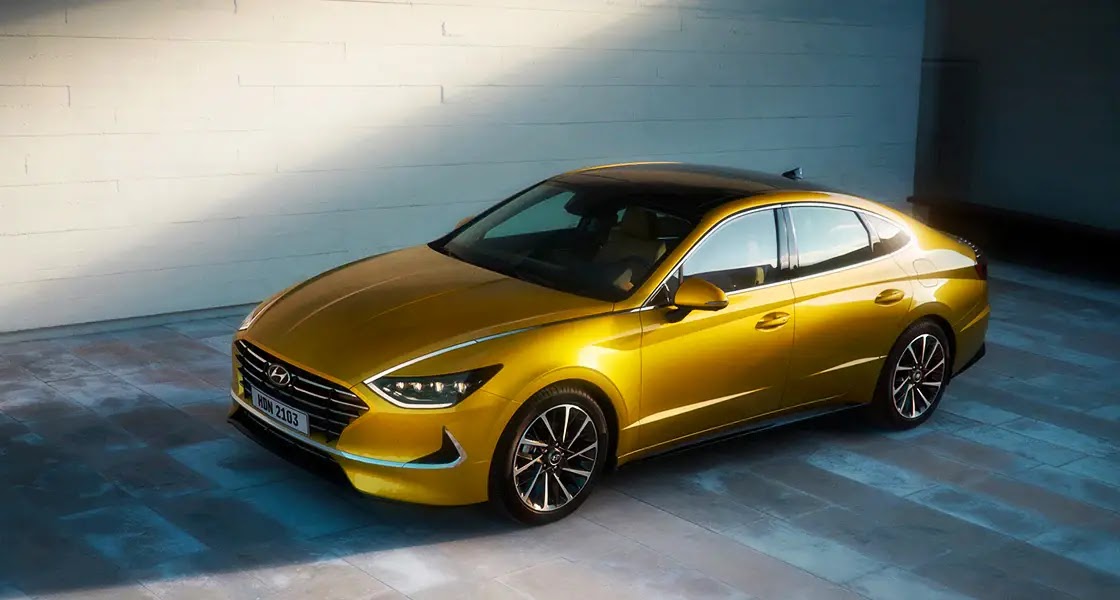
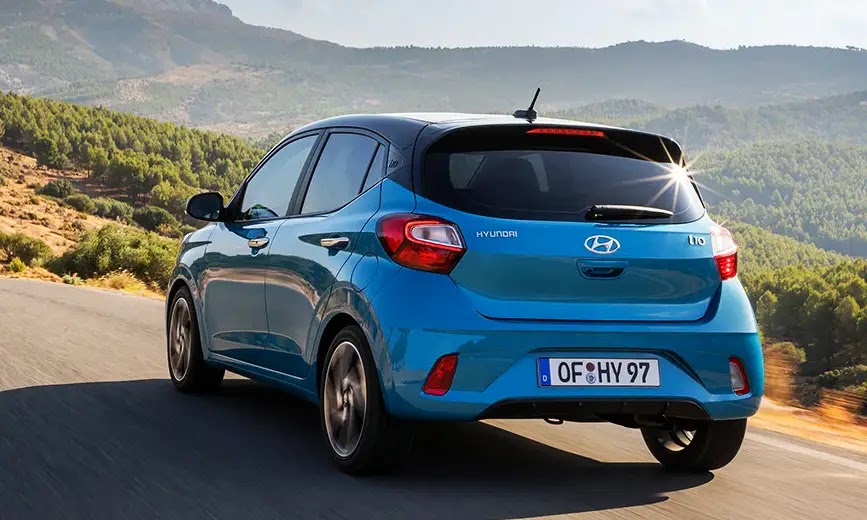
The small i10 car (picture above) is doing well along with its slightly larger sibling, the i20 hatchback. China hasn't been a happy hunting ground for Hyundai of late and that is reflected in the data below. The Sonata (picture below) is a shadow of the car it once was in terms of sales but still has a place in the line up for now.

Data source: Hyundai.

12 February 2023

Kia Factory Model Sales : 2022


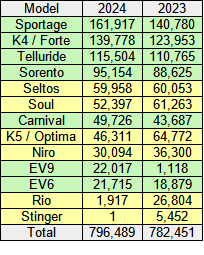
Twentyfour  models were part of the Kia stable in 2022, the Carens being the new kid on the block. It's a resurrected nameplate, but the model has gone from an MPV to a crossover and is now aimed at 'developing' markets.

The total of 2.715 million represents an increase of 7.7%, one I'm sure they will gladly take all things considered. The Sportage SUV retains its top spot with its share of the company sales up from 12.4% to 16.1%. Then came the Seltos of the same genre but smaller and up a whole percentage point to 10.6%.

The only model made in Russia was the Rio in a Hyundai factory I believe and that arrangement has obviously concluded. So Kia is moving along nicely, with headwinds not putting it off course. 

The pictured cars are not big selling models. The car above is the Ray (nice name) which reminds me of Japanese Kei cars. It is only sold in Korea and we see it here it is enjoying the rays of the sun. Below is the Stinger, a model that isn't in a segment that's popular these days. It's lost some of its...er sting.

Data source: Kia. 

11 February 2023

Hyundai Factory Sales : 2022 (By Nation)


It was a trying 2022 for car makers but Hyundai seemed to secure a sufficient supply of semiconductors to actually manage a 3% increase in factory sales. They also had to contend with reduced volume in China and winding down operations in Russia. I presume the latter two negatives freed up chips for elsewhere. 

Just over a third of the unit sales (36.6%) were from plants in Korea, about the same as a year ago. Its lowest level was back in 2016 when it was just under the 30% mark. India's contribution of 19.8% was its highest ever. China (at 7.1% of the cars Hyundai make) was the lowest since 2003 when they were just establishing manufacturing in that country. 

The plant in Indonesia was timely as that market is strongly protected and local production is essential for any hoped for success there. As mentioned, Russian production is over so that will be off the list in 2023. Production in Mexico comes from the Kia plant. 

Data source: Hyundai.


09 February 2023

Kia Factory Sales : 2022 (By Nation)


This was a good year for Kia, with factory sales up 11%. Just over half came from Korean based operations. Kia was slow to open plants elsewhere and after a flurry of action, it seems to have plateaued. India only came on line in 2019 and already looks to be heading for the second spot. 

China started production in 2002 and that the lowest percentage (5%) in terms of contribution since that year. Sales are sluggish and capacity heavily underutilised. Jiangsu Yueda Kia, Kia's subsidiary in China isn't going well so something needs to happen. 

Of course, Russian production is now finished so the last time they will be listed for the foreseeable future. Yet, despite problems in China and exiting Russia didn't stop everywhere else from doing well. 2.8 million units is a strong result. 

Data source: Kia.

08 February 2023

Genesis Global Model Sales : 2021-22

The Genesis marque is a bold attempt to take on the existing premium marques and for now it relies on the domestic market for much of its volume. It helps when the local market is heavily protected by tariffs but it is in no way as effective as it is against mainstream brands. Such cars rely on their reputation and status so cutting in on that is no easy task. Customers in this segment will pay extra for the cachet they carry. 

Global wholesale volume was up 7% in 2022, reasonable in a difficult trading year. In its home market, retail sales were 135,000, down 5%. If I was a high volume premium import brand in Korea, I'd be concerned having an idea of how things work there but I'll leave it at that. 

Unusually, the top three most popular models decreased but were more than offset by the less popular models doing well. The G range of passenger cars claimed 47% of the sales, about 1% up on 2021. The GV crossovers I expected to take more in 2022, not less. Maybe just a temporary aberration. 

Data source: Hyundai.

04 February 2023

Hyundai India Model Sales : 2019-2022


Hyundai sailed into this period with a strong tailwind and looking well established. The market is tight and Tata was was proving to be stiffer opposition so how would Hyundai react.

2019: As usual, with new models keeping the range fresh. The Venue compact crossover (picture below the sales chart) was successful as you would expect and the Kona also turned up but in tiny numbers. 

2021: The small to medium sized Alcazar crossover (above) was introduced and understandably was solid without being spectacular saleswise. Meanwhile, the slow selling Elantra was withdrawn.

2022: Hyundai's market share slipped noticeably to 14.4%, the lowest since 2012 and the second lowest since 2007. It may be a temporary blip but one to watch. India is not, for the most part, an easy place to be in for a car company. Tata is on the up and close to passing it.  

As for the pictures on their website as seen here, they are embarrassing. Computer generated but they are not very well done to boot. It's not just with Hyundai either. It seems to be an increasingly common practice, especially in Asia. You can't beat well taken photographs but can some manufacturers not be bothered?

The first in the series can be seen by clicking here.