21 September 2023

Belgium Ford Model Sales : 1955-59

Ford has been and is a popular brand in Europe. The company had assembly operations in three countries, England, France and Germany. 

Over this period covered, England was the main supplier of models until the Taunus range from Germany began to take centre stage. 

Germany: The Taunus name was used for two separate models. The 12 and 15 were medium sized cars which were eventually replaced by the TC (Cortina in the UK). The larger 17 came later and proved very popular. By 1959, it was taking nearly half of Ford of Europe's sales. 

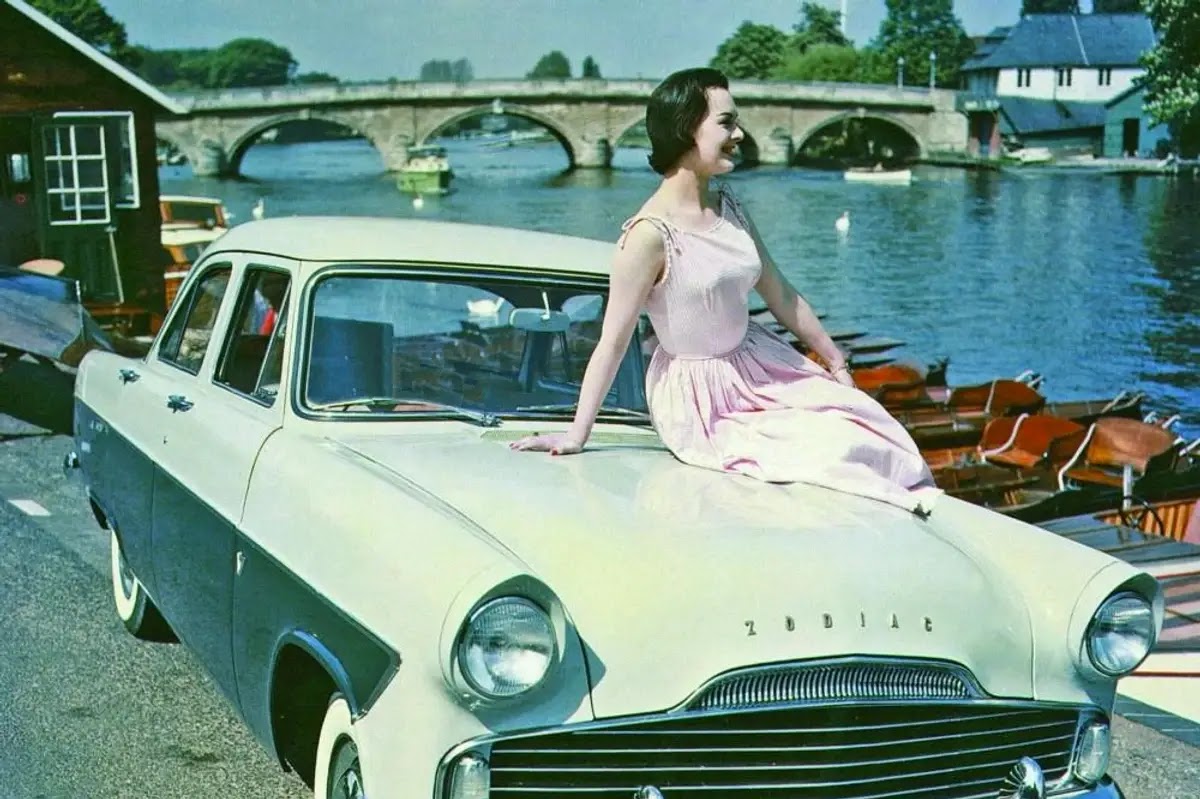
England: This is where most of the models came from at the time. The smaller Anglia and Prefect/Popular models along with the larger Consul/Zephyr/Zodiac range. The latter were similar to the Taunus models in size so basically competing. 

France: Production in France was not as successful and the plant in Poissy was sold to Simca in 1954. Simca continued to make the large Vedette model, some sold as Fords and others under the Simca logo until the model ran out of puff.

Ford US: sales are shown in this second chart as totals by brand name. The Fairlane 500 and Custom 300 contributed most of the sales.

Summary: Total sales for Ford in Belgium dropped nearly a thousand units over this five year period and market share suffered as a result. That retreated from 19% to under 14% but in the years immediately after Ford came back strongly and was the top selling brand in Belgium for many years. 

Data: Statbel. Pics: Zephyr hemmings.com and Vedette simcatalbotclub.com 

17 September 2023

Tata Motors Prod / Sales : 2001/02 - 2022-23


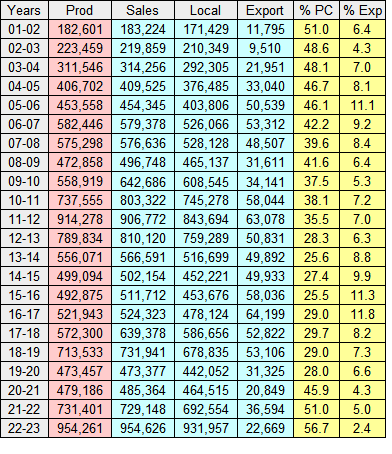
Most people have never seen a Tata vehicle before, yet production and sales were close to 1,000,000 in the 2022-23 year. The reason is that Indian vehicle makers have an extremely protected domestic market and that is where virtually all of them are sold. Countries that have their own vehicle manufacturing will not open their markets unless they can access to the Indian market in return.

So if India allowed better access to its market, it would have better access to many more overseas ones. The issue is are the vehicles made in India of a suitable standard? Up to now not quite but they are not far off. India can export to markets where they do have free access and that is starting to happen.

In the last year on the chart below, of the 954,600 vehicles sold, only 22,700 were exported. That represented just 2.4% of the total. That means that volume can move up and down more dramatically with all the eggs in one basket. Low wages reduce the financial impact of this.

Tata is heavily reliant on commercial vehicles, with a return to more emphasis on passenger cars taking place. Back in 2000-01, PCs made up 51% of units sold, but that had halved by 2015-16. It's now back up to 56.7% and climbing. 

The Indian government wants to reduce protection but manufacturers in general are very much against it. I think the local market wouldn't be swamped with imports if tariffs were reduced or eliminated. The price of a vehicle is still an important factor and domestic manufacturers have a low wage structure as an advantage. 

The problem is trying to sell vehicles in mature markets with products that still need to improve in their quality. 

So with little chance to improve exports with better trade deals, manufacturers will naturally want to protect their home patch. That despite the likelihood of their being overrun at home is zero.  

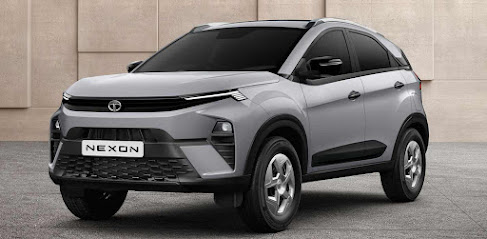
In summary, Tata has an expansive range of trucks with an increasing range of passenger vehicles. The time to push toward a greater export focus is surely planned as quality improves. 

Data source: Tata Motors.
16 September 2023

Belgium 1,000 Club : 1964


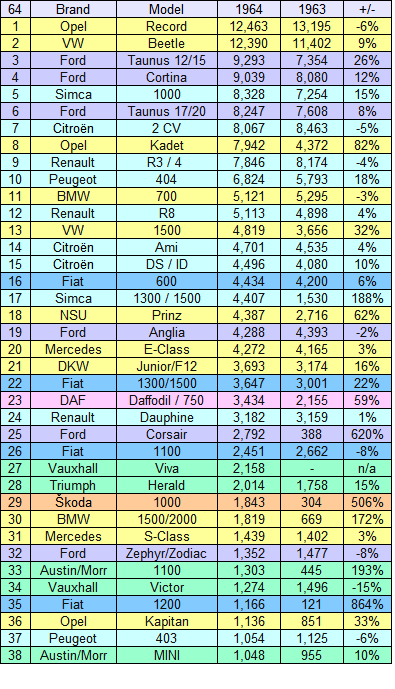
There were at least 37 models that exceeded 1,000 sales in 1964. I say "at least" because I couldn't get a model breakdown for Volvo which would have had representation here otherwise. Chevrolet may have too. 

The chart is rather colourful but they are broken down by where the brand originated. It's handy if you want to focus on a country of origin in particular. All the cars listed would have been made in Europe and there were no sales of Asian brands at all, a contrast with today. 

The data wasn't presented on a platter so some work was required in some cases to sort it out. That's not a criticism by any means, it's nice to have access to it at all. It's just occasionally a bit of estimating was used. 


I'll mention a few examples. The Ford Taunus had about 1,100 sales not differentiated between models so using data from surrounding years, I estimated how to allocate them. The NSU figure was just a total and I think only one model was available at the time so all sales went to the Prinz model. Škoda also had some unallocated units but likely for the 1000 model. 

Overall, an insight into a time when many of you were very young or not yet born. The model ranges were less extensive, the cars far less complicated and owning a car at all was still a relatively new experience for many. 

The pictures are at top the Renault 4, then the BMW 1500 and finally the Škoda 1000. In the last pic, an interesting way to flag down a passing motorist.  

Data source: Statbel. Pictures: Netcarshow.